
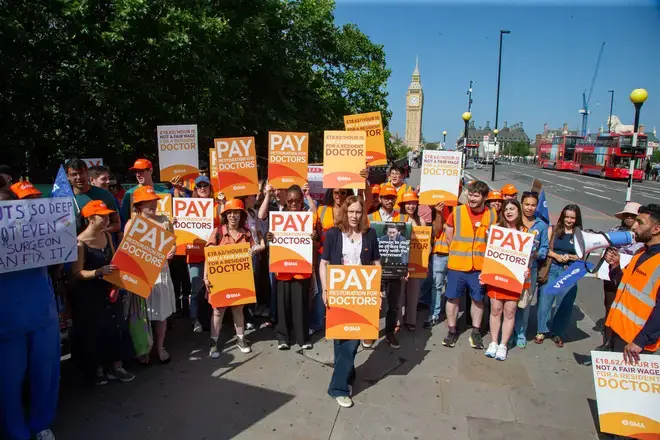
Only 33 per cent of junior doctors said they agreed the walkout should go ahead
Resident doctors – formerly known as junior doctors – began the walkout over pay after the British Medical Association (BMA) rejected a reforms package from Health Secretary Wes Streeting.
The Health Secretary's offer was dismissed within hours, without the package even being put to its members for a vote.
The strike, which got underway at 7am on Friday, led Mr Streeting to hit out at union bosses, suggesting the body was 'behaving like a cartel' when it came to pay demands.
Mr Streeting hit out at “leadership that has truly lost the plot” as crippling NHS strikes got underway.
NHS Confederation and NHS Providers, which represent health trusts, said continued action was piling pressure on already-stretched budgets.
It comes as a new Times poll suggesting only 33 per cent of junior doctors now agree with the walkout following an initial 5.5% pay rise for the 2024/25 financial year, backdated to April 2024.
The five-day action is the 13th walkout by doctors since March 2023, with the last strike in July estimated to have cost the health service £300 million.
Resident doctors make up around half the medical workforce in the NHS and have up to eight years’ experience working as a hospital doctor or three years as a GP.
After the poll was published, Mr Streeting said that the health union seemed intent on "causing pain to patients" and accused bosses of being "out of touch".
He said: “Patients don’t want the strikes to go ahead, and now it’s apparent that resident doctors don’t either — yet the BMA rejected the government’s offer out of hand.
“What kind of trade union stands in the way of more jobs for and more money in the pockets of its members, when that is the deal its members want? The BMA’s leadership appear more interested in grandstanding and causing pain to patients than improving the lives of frontline resident doctors.
“The BMA’s leadership is out of touch with frontline doctors. It is going against the wishes of members, who do not want strikes to go ahead.”
NHS Confederation and NHS Providers said that if the NHS continues to have to foot the bill from strikes, it could lead to staff being cut and fewer tests, appointments and operations being carried out.
The knock-on impact on patients is they will be forced to wait longer for care, and many may no longer be able to work without the treatment they need, they said.
According to the poll, 48 per cent of those polled said the strike should have been called off and the remaining 19 per cent were unsure, according to the survey by Savanta.
And the poll suggests that the last-ditch deal offered by Mr Streeting would have been accepted by members of the BMA.
The Department of Health and Social Care's (DHSC) offer included doubling of "additional" speciality training posts to avoid doctors being out of work, and other incentives including covering the costs of mandatory exams and membership fees.
However, the Government has flatly refused the headline pay demand of 28.9 per cent in negotiations.
The strike will coincide with a deadly flu surge – as well as jeopardising progress on bringing down NHS waiting lists which stand at 7.39 million.
Earlier this week, Mr Streeting told LBC that he backed the head of the NHS in telling hospitals to go ahead with nearly all planned operations during the resident doctors' strikes.
The Health Secretary said that bosses must do "everything we can to keep this show on the road".
His words echoed those of NHS chief Sir Jim Mackey, who wrote to NHS trusts saying they should cancel as few operations as possible to combat the long delays already faced by many patients.
He told hospitals to maintain planned care “to the fullest extent possible – with at least 95 per cent of elective activity continuing compared with what would otherwise have been expected”.
Describing Sir Jim as an "excellent leader", Mr Streeting admitted "it was not going to be easy" to meet his targets.
"I'm not saying the target will be met. It's a challenging target, but we've got to do everything we can to keep this show on the road," he told Nick Ferrari at Breakfast.
Friday's industrial action by the The British Medical Association (BMA) will be the 13th resident doctor walkout since March 2023 amid a long-running pay dispute.
Hospitals are also being urged by Sir Jim not to pay “extortionate” senior doctor rates set by the British Medical Association (BMA), with any “incentivised pay rates” falling within normal ranges.
In response, Dr Tom Dolphin, the BMA’s council chairman, said on Tuesday: "It’s unfortunate that NHS England would once again risk patient safety by instructing trusts to continue the full volume of elective procedures during industrial action.
"If trusts genuinely believe they can provide adequate safety cover to maintain elective activity at the level NHS England is demanding, despite significant numbers of staff being absent, that is their decision. However, they must remember that patient safety must always be the priority.
“In the last round of action, we received a large number of requests to be exempted from strikes from a handful of trusts who hadn’t planned appropriately despite plenty of warning. This was deeply disappointing from senior managers who should be focusing on safety and not political targets.”
