
Hitting back at the Health Secretary, the British Medical Association told LBC his offer to end the strikes is an “insult"
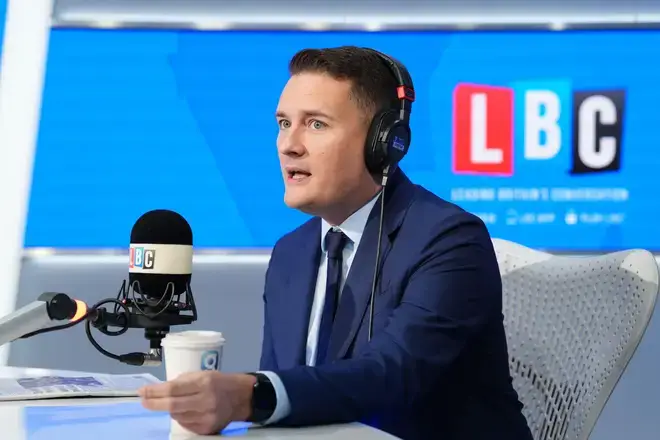
Taking calls on LBC, Wes Streeting told caller Niraj, who is a resident doctor, that he doesn't accept the claim that striking resident doctors don't want to take action.
Niraj told Mr Streeting: "Of course we all care about patient safety. None of us wants to be on strike. I would rather be at work today."
Mr Streeting passionately and strongly rebutted the claim telling the doctor: "On pay, on speciality training places, on improvements to conditions, I have been working to address every single one of those issues.
"These are not the conditions in which people go out on strike. Strike should be a last resort.
"And I'm sorry, but when you say I don't want to be out on strike today. Yes, you do, because you have made that choice."
Hitting back at the Health Secretary, the British Medical Association told LBC his offer to end the strikes is an “insult.”
Dr Jack Fletcher, BMA resident doctors committee chairperson, told LBC: “Resident doctors are on strike today over two issues: jobs and pay.
"This year we had 30,000 doctors applying for 10,000 jobs. That means around 20,000 fully-qualified doctors are being turned away from jobs that mean they can become consultants and GPs.
“This is absurd when patients are struggling to get an appointment with their GP, or being treated in hospital corridors after waiting hours on end to be seen.
“At the same time, resident doctor pay is still a fifth lower in real terms than it was in 2008.”
“Yet when it came to talks, what was proposed by the Health Secretary on jobs went nowhere close to what was needed, and he continued to refuse to discuss pay
“So when he asks why we didn’t put this ‘offer’ – in so much as it was – to our members, the answer is that it would have been an insult."
Dr Fletcher also rubbished a survey cited by Mr Streeting which suggested the majority of resident doctors are against strike action.
“As for this ‘survey’, it was of around 200 resident doctors – out of 77,000 working in England,” he said.
“It in no way reflects the profession as a whole. Support for industrial action has already been decisively demonstrated through 30,000 resident doctors voting to take industrial action, and from discussions taking place in doctors’ offices, WhatsApp groups and online. This weak attempt at polling does not reflect the reality of how frustrated and demoralised doctors are about the jobs and training crisis.
Resident doctors do not take the decision to strike lightly.
“They do so because without addressing the erosion of pay, and the employment crisis they are currently facing, the NHS will continue to lose doctors faster than it can train them — putting patient safety and the future of the health service at risk.”
Speaking to LBC early on Friday, Mr Streeting noted that resident doctors have had a 28.9% pay rise, the highest in the public sector two years in a row.
He accused doctors of "holding patients to ransom" and setting the NHS back.
He said: "To be out on strike setting back the NHS because you don't think we're going fast enough and because the leadership of your union are not honest enough. That some of this change takes time is extremely irresponsible.
"It is extremely unnecessary."
"So don't tell me you don't want to be out on strike because that's exactly where you are. You made that choice. Own it and own the damage it will do to your patients," he added.
Mr Streeting also accused the union the BMA of ‘reprehensible’ and ‘cartel-like’ behaviour. He said he doesn’t believe the BMA represents its members and is now representing a group of ‘activists’.
“It is no longer a professional association, and it is engaged in cartel-like behaviour," he added.
Niraj had confronted the health secretary about whether he values the work of resident doctors, asking: "Why should we take you seriously when the proposals that you've put forward to end industrial action are simply what anybody would expect from a reasonable employer? And that should already be in place.
"Things like funding our mandatory exams and portfolio and college fees and ensuring that there are enough training places to make sure that the public have enough consultants in the future.
"So all of those things, in my opinion, should already be in place. They shouldn't be a bargaining chip to try to end this dispute."
Mr Streeting admitted that "things aren't good enough for resident doctors", but said they have taken steps to bring forward training places, and settled previous demands for a pay rise.
Thousands of resident doctors go on strike across England on Friday in a dispute over pay, the NHS Confederation and NHS Providers, which represent health trusts, said continued action was piling pressure on already-stretched budgets.
The five-day action is the 13th walkout by doctors since March 2023, with the last strike in July estimated to have cost the health service £300 million.
Resident doctors make up around half the medical workforce in the NHS and have up to eight years’ experience working as a hospital doctor or three years as a GP.
NHS Confederation and NHS Providers said that if the NHS continues to have to foot the bill from strikes, it could lead to staff being cut and fewer tests, appointments and operations being carried out.
The strike comes as polling in The Times suggested 48% of resident doctors wanted the action called off, and only 33% thought it should go ahead.
In the hours after Mr Streeting's furious rant, LBC received an email from a resident doctor who had planned to strike today.
Instead, after hearing the Health Secretary's words, they decided to go to work instead, working a shift in A&E.
