
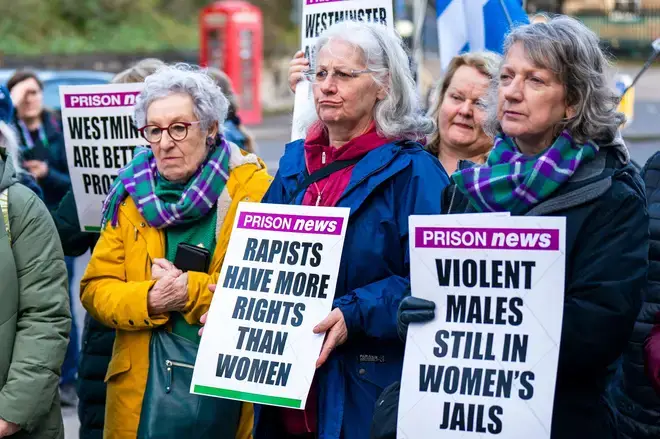
On the final day of the judicial review hearing into the Scottish Government’s transgender prisoner policy, the current case-by-case approach was defended by Gerry Moynihan KC.
The policy is being challenged in the Court of Session by women’s organisation For Women Scotland, who say it breaches the Equality Act in terms of single sex spaces and the Supreme Court ruling of last April, that when providing such spaces, they are segregated based on biological sex and not gender identity.
Citing Article 8 of the European Convention on Human Rights in relation to the rights of trans people to live in their acquired gender, Mr Moynihan said yesterday: "Where a transgender prisoner does not threaten the rights of others – are we to have an absolute rule that says that they must be accommodated in a prison of their sex?
"Why? The sole reason is that they are to be classified as a man. Even though they live their lives as a woman.
"It's a fundamental denial of their choice of gender. And it's a fundamental denial driven only by semantics."
He argued that there was a need “to go beyond stereotypes”and that ministers cannot ignore any risk of suicide which may arise from transgender prisoners being housed in facilities according to their biological sex.
He said that the mental health of transwomen prisoners – men who identify as women – was harmed when they were in the male prison estate as their “identity is being challenged.”
He added: “Suicide is a fact, Scottish ministers cannot operate a regime where they promote a risk of suicide.”
Mr Moynihan also argued that moving transwomen into the female prison estate would help with their rehabilitation for their release as a “transwoman will return to the community as a transwoman".
And he spoke against a proposal that a separate unit could be established for transgender prisoners as it would be small and therefore costly, and not be geographically suitable for prisoners so they could be visited by family.
He added: “This case engages very complex difficult judgments. What is being asked in this case is that they be put in a straitjacket.
"That their best prison management judgements are constrained by an artificial parameter, that they must define a man as a man and a woman as a woman full stop, without exceptions.
“Ministers are here to protect the flexibility because that is what is judged to be necessary to achieve the objectives of managing prisoners safely and in the public interest, rehabilitating them to the best of their ability."
The court also heard further arguments from Aidan O'Neill KC, who is representing FWS.
He referred to an affidavit from former prison governor Rhona Hotchkiss, saying a special unit for trans prisoners could be set up "quite easily".
The KC also sought to refute claims from the Scottish Government that the risk of potential suicides among prisoners meant the authorities had to take a case-by-case approach for transgender inmates.
Mr O'Neill said: "Why does the threat of suicide give you a power to direct the prison authorities as to how you should be treated?"
He had told the court on Tuesday that there was "incredible sensitivity" to the rights, dignity and privacy of trans people, while the rights of "incredibly vulnerable" female prisoners were not factored in.
He said the government wanted to retain the flexibility to put "a totally non-violent trans-identifying man" in the women's estate but questioned why female prisoners had to "bear the risk" of this and act as "human shields".
The judge considering the challenge, Lady Ross, said she would not be able to deliver any decision "very rapidly".
She told the court: "I hope it will be appreciated that withstanding the arguments that have been advanced and the complexity of some of the underlying issues, that it will take a little while."
She said she would deal with the issue "as quickly as I reasonably and responsibly can".
Lady Ross added: "I would not want there to be any expectation that this will be out very rapidly."
The latest case comes in the wake of the outcry over trans rapist Isla Bryson – formerly known as Adam Graham – who was initially sent to Cornton Vale women's prison in Stirling after being found guilty of sex attacks on two women in 2023, before being moved to a male prison.
There are believed to be 19 transgender prisoners currently held in Scottish jails.
