
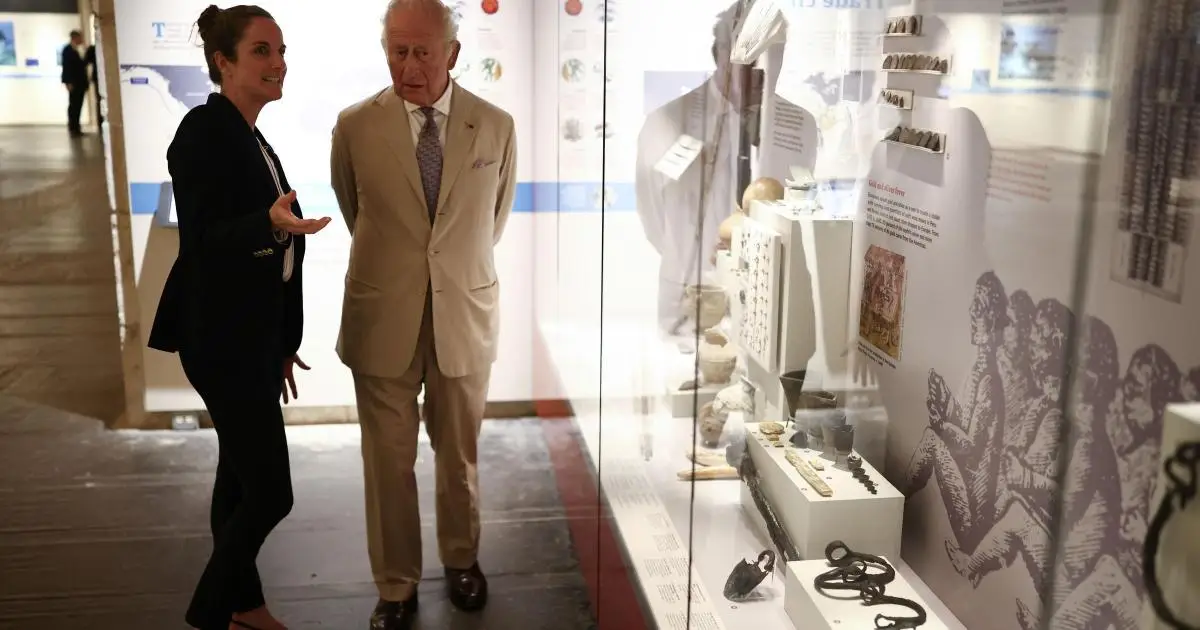
The King was shown slavery artefacts from Bermuda’s past as he celebrated the island’s culture, people and achievements.
Charles toured an exhibition space during a whirlwind series of events across the island paradise and viewed items relating to the transatlantic slave trade, including neck irons from the 1500s.
The head of state received a warm welcome from thousands of well-wishers in the heart of the British overseas territory’s former capital, St George’s, during a ceremonial greeting full of military pomp.
He then travelled from end-to-end of the island, meeting youth groups, conservationists of the future, the territory’s leaders and even Bermuda-born Michael Frith – designer of many of the Muppets characters – and his wife, Kathryn Mullen.
Charles viewed the small but stark display at the 1850 Ordnance House – part of the National Museum of Bermuda – that traced the darker moments in the island’s history, with a cabinet dedicated to trade, slavery and conquest.
It included a drawn image of shackled men sitting in a slave ship and several examples of neck irons.
During his day on the island, Charles also watched a performance of the island’s Gombey dance tradition – an expression of culture that had been restricted during slavery to just a few times a year.
The King watched men and some children dancing in neon-coloured outfits with tassels on their trousers, elaborate masks and tall pointed headgear topped off with plumes of ostrich feathers.
Irwin Trott, spokesman for the Bermudan Gombey dance troops, said after meeting the King: “I told him that it’s a combination of cultures, African, Caribbean, West Indian, Native American and, of course, Great Britain.
“Gombey is a premise from the Atlantic Slave Trade when they were brought over by the colonisers and shipped to New England and the Caribbean islands.
“Even though they were stripped of their identity, names were taken, their language was taken, deep in their heart they maintained their culture, and so it still flourished throughout the Caribbean.
“It was prohibited, so they were only permitted to perform on Christmas and New Year’s.”
