
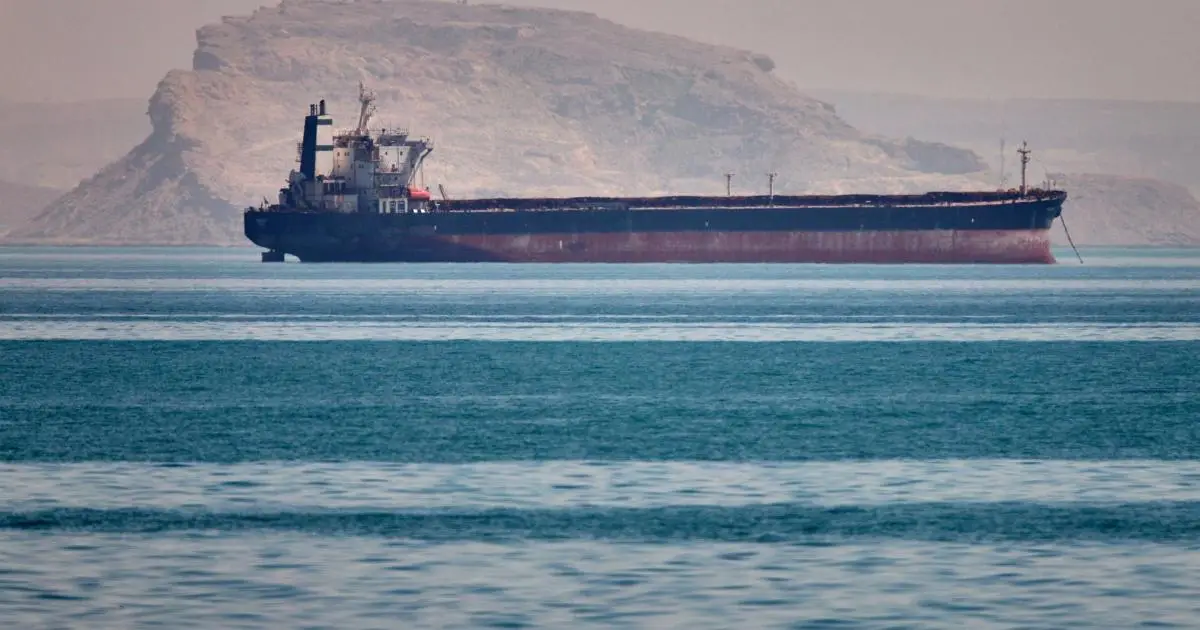
The UK will deploy autonomous mine-hunting equipment, “cutting edge” anti-drone systems and Typhoon jets for its Strait of Hormuz mission, the Defence Secretary said.
John Healey made the announcement as Britain and France hosted a meeting of 40 defence ministers on Tuesday about plans to protect shipping in the critical waterway once hostilities cease in the conflict.
The package includes autonomous mine-hunting equipment, a system which can can deliver high-speed autonomous Kraken drone boats and Typhoon jets for air patrols.
Proud to co-chair today’s Strait of Hormuz Defence Ministers meeting of 40+ nations, united behind a credible, defensive mission.
The Strait carries a fifth of the world’s oil. Securing freedom of navigation matters for people at home & globally, and the UK is leading the effort pic.twitter.com/5ll3NcC54e
— John Healey (@JohnHealey_MP) May 12, 2026
The UK had already announced the deployment of HMS Dragon to the region so the destroyer can play a role in the multinational mission, should the conditions allow.
Support ship RFA Lyme Bay is also being converted to act as a mother ship to mine-hunting drones, which could help clear shipping lanes.
Mr Healey said: “With our allies, this multinational mission will be defensive, independent, and credible.”
Chancellor Rachel Reeves also approved £115 million for mine-hunting drones and counter-drone systems.
The sea route, which is a major supply line for oil and gas supplies, had been open prior to the US and Israel launching strikes against Iran.
.@POTUS: “We have Iran very much under control. We’re either going to make a deal or they’re going to be decimated — so one way or the other, we win.” pic.twitter.com/iSSM1vJNsU
— Rapid Response 47 (@RapidResponse47) May 12, 2026
In retaliation, Tehran effectively closed the shipping lane, sparking a global energy crisis that has seen prices rocket.
This led the US to impose its own blockade of Iranian ports, leading to a stand-off.
US leader Donald Trump said the Iran ceasefire was on “life support” and dismissed Tehran’s peace proposal as “garbage”, causing oil prices to again increase sharply.
Efforts to reopen the Strait of Hormuz were the focus of recent talks between US secretary of state Marco Rubio and UK Foreign Secretary Yvette Cooper.
Mr Rubio was recently critical of the post-conflict operation, questioning the involvement of countries “after it’s over”.
He said: “Well, after it’s over it’s kind of like – it doesn’t make sense.”
Mr Rubio did then concede there may be “some utility” in such an action.
US defence secretary Pete Hegseth has been more forthright, dismissing the efforts being led by the UK and France as “silly”.
Top American military commander General Dan Caine has also argued “now is the time” for countries with an interest in the strait to assist the US.
In a statement issued late on Monday, state department spokesman Tommy Pigott said: “Secretary of state Marco Rubio spoke with UK Foreign Secretary Yvette Cooper today to discuss Iran and ongoing efforts to restore freedom of navigation in the Strait of Hormuz.”
Meanwhile, the UK has issued 12 new sanctions targeting Iranians accused of planning attacks in Britain on behalf of Tehran.
In an update to the official sanctions list on Monday, the Foreign Office imposed travel bans and asset freezes on nine people for carrying out “hostile activity” in the UK and elsewhere.
Ms Cooper said the move “directly targets organisations and individuals who threaten security on UK streets and stability in the Middle East”.
She added: “Criminal proxies backed by parts of the Iranian regime who threaten security in the UK and Europe will not be tolerated, nor will illicit finance networks.”
Another three sanctions were issued on entities including the Zindashti Network, sanctioned last year by the EU and said to be connected to Iran’s Ministry of Intelligence and Security.
According to the EU, the Zindashti Network has “carried out numerous acts of transnational repression” for the Iranian government, including kidnappings and assassinations of critics of the Tehran regime.
Among those sanctioned are five members of the Zarringhalam family – Farhad, Fazlolah, Mansour, Nasser and Pouria – said to have helped finance efforts to “destabilise” the UK.
Mansour, Nasser and Fazlolah Zarringhalam were sanctioned by the US last year for their involvement in Iran’s “shadow banking” network.
The US Treasury said the trio had “collectively laundered billions of dollars” for Iran through a network of front companies in the UAE and Hong Kong.
Berelian Exchange and GCM Exchange, companies linked to their network, were also sanctioned on Monday.
Others accused of “threatening, planning or conducting attacks” in the UK or elsewhere include Turkish national Ekrem Oztunc, Azerbaijani national Namiq Salifov and Iranian national Nihat Abdul Kadir Asan.
