
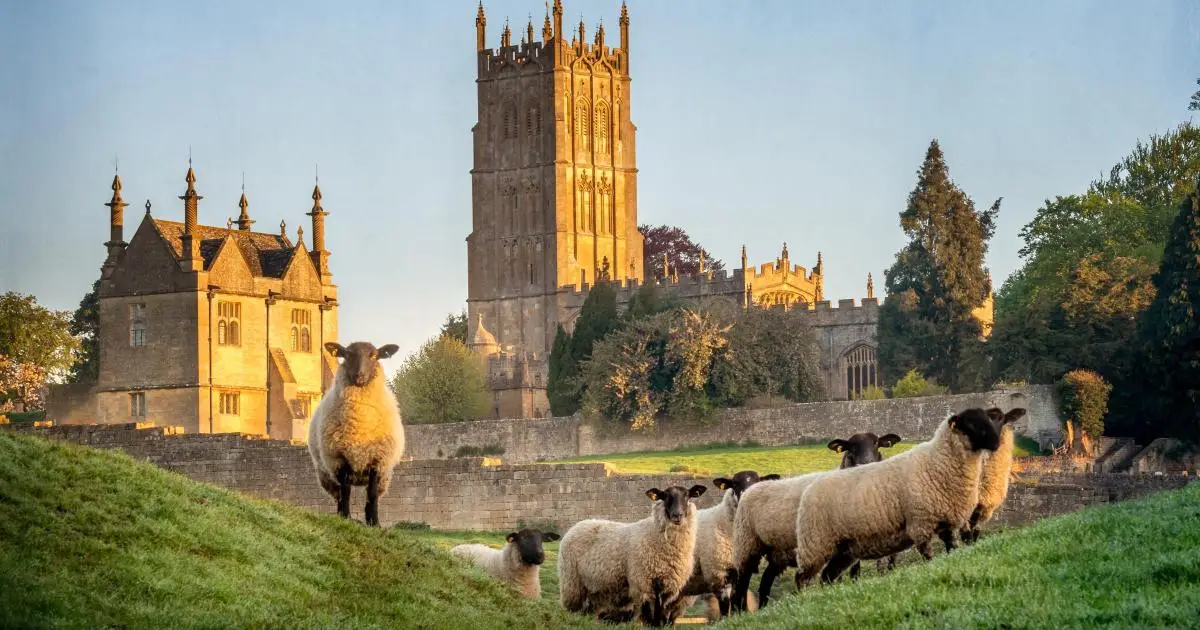
Medieval churches are among the built glories of the Cotswolds, towering beacons within the landscape and communities of towns and villages. Among them are our much-cherished ‘wool churches’ – a term of modern invention rather than a formal group, says architectural historian Dr Nicola Coldstream, author of Churches of Gloucestershire and Churches of Oxfordshire available from Amberley Publishing.
‘What we call the wool churches were simply the new parish churches in the more prosperous wool towns, built at times of prosperity between the 14th and early 16th centuries,’ explains Nicola. ‘Wool money undoubtedly contributed hugely to building work, but these parish churches were almost always communal efforts, with the entire parish chipping in. In style they followed the current fashion for spaciousness, wide aisles and large windows, all features of the Perpendicular (modern term) style that they helped to perpetrate.’
Nicola points out that some churches, including at Northleach, Chipping Campden and Chipping Norton, share a distinctive characteristic at the level of the upper windows in the nave.
‘Where the nave is two-storey and the chancel much lower, the end wall of the nave rises above the chancel roof,’ she says. ‘The clerestory is carried over the chancel arch, so that there is a window in the upper east wall.’
Almost all ‘wool churches’ are built of local limestone of varying hues.
‘Otherwise the churches exemplify a truth that becomes very apparent when you look at them, that no two are ever quite alike,’ says Nicola.
‘In the design either of columns or window tracery (where masons exercised their genius), and it seems clear that each parish deliberately chose something different from its neighbours.’
Village sign Northleach.
CATHEDRAL OF THE COTSWOLDS
The churches certainly offer a diversity of treasure-filled history: from St James’ Church, Chipping Campden, with its 15th-century brass recalling William Grevel, ‘flower of the wool merchants of all England’, to Burford Church with its striking monuments or Henry VIII’s barber and the ‘terrible Tanfields’.
A church existed in Northleach from at least the time when the market charter and annual fayre were granted in 1227, but today’s St Peter and St Paul largely dates from rebuilding in the Perpendicular style in the 15th century. Known as the Cathedral of the Cotswolds for its impressive scale, it has many remarkable features, says Richard Owen, head of the Church Welcome Team and secretary of Northleach Historical Society.
Not least is the outstanding collection of memorial brasses depicting Northleach wool merchants and their wives, commemorating many of those whose wealth built the church: in particular John Fortey who included in his 1458 will the huge sum of ‘£300 to carry on and complete the new work already by me begun’. The roof of the nave was raised and clerestory windows installed, achieving his wish to make the church ‘more lightsome and splendid’.
The church has a team of 50 welcomers who between them greet visitors, and from April to end-September when they are on duty, they meet some 12,000 people, Richard says. ‘Some visitors come in for peace and quiet and to pray; others want to know about the history or to look for ancestors. An Italian visitor found his ancestor commemorated by a brass – a wool trader called Robert Serche (d. 1501) who fell in love, married a local girl, Anne, and stayed in Northleach.’
Ancient monument, gallery of art and craft, keeper of human stories through the centuries: a church is all of these, giving a sense of connection and continuity.
‘People really value the church as an historical asset as well as the idea that this building in the midst of our community at Northleach points to something bigger,’ says Reverend Charlie Styles. The reverend says he has noticed interest rising, in particular among younger people, who in our anxious times show a curiosity to explore ideas and different answers to life questions. ‘Bringing together spiritual and secular, the church has always been a place for worship, to mark life events and provide a focal point for different community groups,’ he says. ‘Its superb acoustics make it a popular venue for concerts and talks, many hosted by the Friends of Northleach Church who help to raise funds for ongoing maintenance and repairs. Next year marks the 800th anniversary of the town’s market charter and fayre “on the vigil, the feast [June 29], and the morrow of SS Peter and Paul”. Celebrations are already being discussed with the town council.’
Interior detail St Peter’s Church Winchcombe.
HUB OF THE COMMUNITY
St Peter’s Church at Winchcombe is another hub of the community, with ‘lots going on,’ says Reverend Captain David Penny, priest-in-charge of the parish of Winchcombe with Gretton, Sudeley Manor and Stanley Pontlarge. Worship thrives; there are bellringers, a choir with wide-ranging repertoire, concerts, a supportive Friends group and stewards to welcome visitors.
St Peter’s offers a particularly beautiful wedding venue, Rev David says, and Sudeley Castle ‘has a really nice place for receptions just up the road.’ While it has always been the role of St Peter’s ‘to serve and support the community’, some of the ways in which it does this have changed, Rev David says.
‘Back in the 15th century there wouldn’t have been much call for youth work for example. There would have been no sense of anything like Winchcombe Pride that we are starting this year. These sorts of things have changed, and quite rightly as a church we keep up with the needs of the community.’
The church works with schools and has The Beacon drop-in youth space. “We are there to support and encourage the young people of the town in all they do.”
Winchcombe’s history is steeped in tales of Saxon royalty, pilgrimage to the shrine of St Kenelm (murdered heir of King Kenulf of Mercia) in the now-vanished abbey, and medieval wool wealth. A church dedicated to St Peter existed by the 12th century but today’s Perpendicular-style building dates from the 15th century and was funded by the town, abbey and Ralph Boteler, Lord Sudeley.
Visitors to the church, who come from all over the world, are often walkers from the Cotswold Way or Winchcombe Way, or generally interested in the town’s heritage and Sudeley Castle. Many find a real sense of peace within the church, Rev David says.
‘And they are blown away by the many things that speak of its history, of the history of the town and even the country.’
Aside from the 40 grotesques that famously adorn the outside of the church, Rev David highlights three of his favourite features: A medieval altar cloth c1460–1470; a sarcophagus which could have been the resting-place of St Kenelm (or of similar type); and a memorial to Thomas Williams (d. 1636) kneeling in front of a prayer desk with a space opposite left for his wife.
‘But she remarried and was never laid to rest with him – a little love story in a way but tragic in another.’
So many tales to discover: at the heart of the community..
