
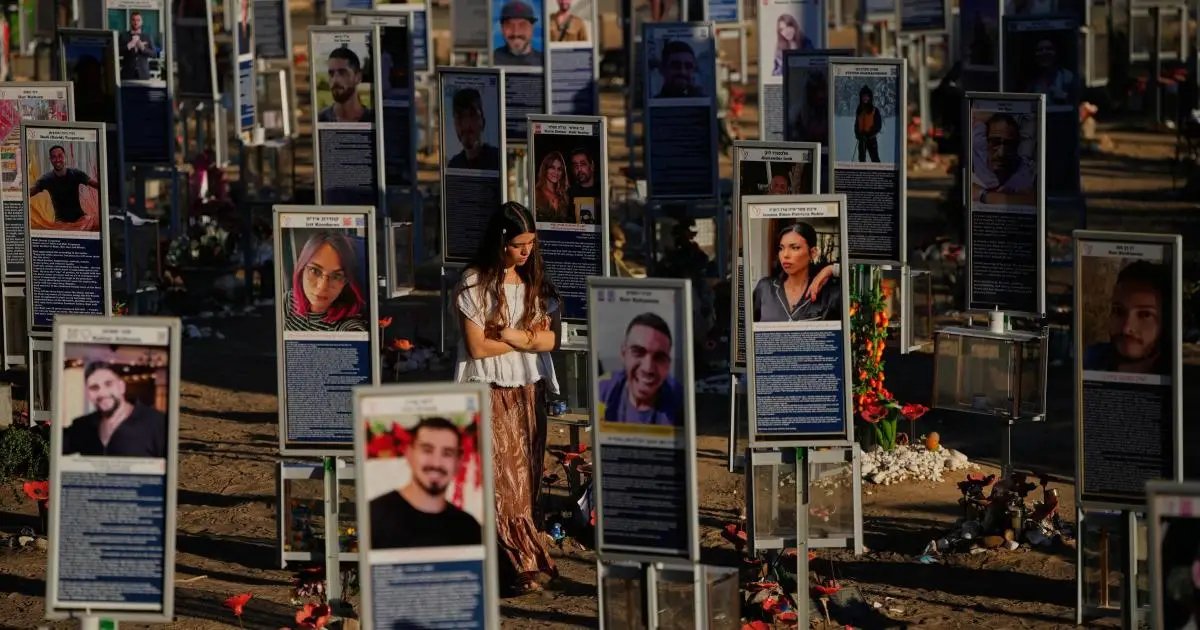
Israelis embraced and wept on a field where music festival revellers were shot by Hamas-led militants three years ago, as they remembered those lost in an attack that plunged the Middle East into war.
Israelis mourned at the site of the Nova Music Festival, as well as at bomb shelters, crossroads and in communities targeted on October 7 2023.
On this day — the deadliest in the country’s history — militants killed 1,200 people and took 251 hostage.
Israel’s retaliatory offensive killed tens of thousands of Palestinians, destroyed much of Gaza and drove most of its two million residents from their homes.
This is the first anniversary since all the hostages, living and dead, were returned.
Signs calling for their return are mostly gone, but reminders of those who were killed are ubiquitous in a country still reckoning with the trauma of that day.
For Palestinians, the anniversary brings another day of fear and misery.
Most Gaza residents live in squalid tent camps, with large parts of cities bombed to rubble.
More than half the territory remains in the hands of the Israeli military.
Despite a ceasefire deal reached nearly a year ago, Israeli strikes continue almost daily.
Israeli troops occupy a large chunk of southern Lebanon in their conflict with Hezbollah militants, who began firing on Israel in 2023 in support of Hamas.
Iran, the US and their allies are locked in a confrontation that has seen attacks across the region and has shaken the global economy — a conflict that Israel helped launch and that the war in Gaza paved the way for, even if they were not directly connected.
Hundreds of people paid their respects to the more than 350 people killed in and around the festival site.
Videos from that day showed militants shooting fleeing revellers as well as the wounded at point-blank range and ambushing those seeking refuge in bomb shelters.
On Wednesday, survivors’ relatives hugged at 6.29am — the exact time the first rockets were launched three years ago — as explosions sounded in nearby Gaza.
No events were expected in Gaza, but Hamas in a statement defended the October 7 attack, saying it had returned the Palestinian cause to the world’s attention.
“The conflict with the enemy did not begin on that day, (and) its final chapters are not written yet,” it said.
Palestinians in the territory said their suffering over the past three years had previously been unimaginable.
“We witnessed death, destruction, and bombardment that we had never known before,” Walid Akram, a Gaza City resident who, like most in Gaza, has been displaced by the war said.
More than 74,000 Palestinians have been killed in Gaza, according to the territory’s health ministry, which does not distinguish between civilians and militants in its figures but says around half were women and children.
The numbers from the ministry, part of the Hamas-run government, are seen as generally reliable by UN agencies and independent experts.
While a ceasefire that took effect on October 10 2025 halted the heaviest fighting, Israeli strikes have continued, targeting what Israel says are Hamas militants.
Since the ceasefire, 1,460 Palestinians have been killed in Gaza, according to the ministry.
Five Israeli soldiers have been killed in attacks in that period.
Restrictions on the entry of goods and aid have contributed to a hunger crisis, food security experts say.
A contentious election at the end of the month hangs over this year’s anniversary in Israel.
Voters are bitterly divided over Prime Minister Benjamin Netanyahu’s leadership, his role in the security failures surrounding the attack and his refusal to launch an official inquiry into them.
The attack set in motion a cascade of events that led to wars across the Middle East as Israel confronted Hamas, Hezbollah and their backer, Iran.
Israel has seized swaths of territory in Syria and Lebanon, where more than 300,000 Lebanese remain displaced.
The US joined Israel in attacking Iran’s military and nuclear programme in two rounds, battering Iran and upending global markets far from the battlefield.
Violence has also risen across the Israeli-occupied West Bank, where Israel’s far-right government has heightened restrictions on Palestinians while emboldening extremist settlers who have attacked them and destroyed their property.
On Wednesday, Israeli settlers opened fire on olive harvesters in the West Bank, killing a Palestinian officer who responded to the attack and wounding 16, Palestinian officials said, the latest in a series of violent attacks since the harvest began this month.
In a second attack on Wednesday, dozens of settlers chased olive harvesters from groves, forcing them to take shelter in a house near the village of Marda in the northern occupied West Bank, Bassam Abdah, a former head of the village council, said.
Israeli soldiers fired tear gas at residents near the house and detained three people, Mr Abdah said.
Five Palestinians have been killed and more than 100 injured this week in such attacks, according to Palestinian officials. They say Israelis have damaged thousands of trees, costing farmers hundreds of thousands of dollars.
Elsewhere, an Israeli drone strike killed one older man and wounded seven other people in southern Gaza on Wednesday, according to health officials.
Dr Mohamed Saqr, a manager at Nasser Hospital, told The Associated Press that one of the injured was in a critical condition.
The Israeli military had no immediate comment.
