
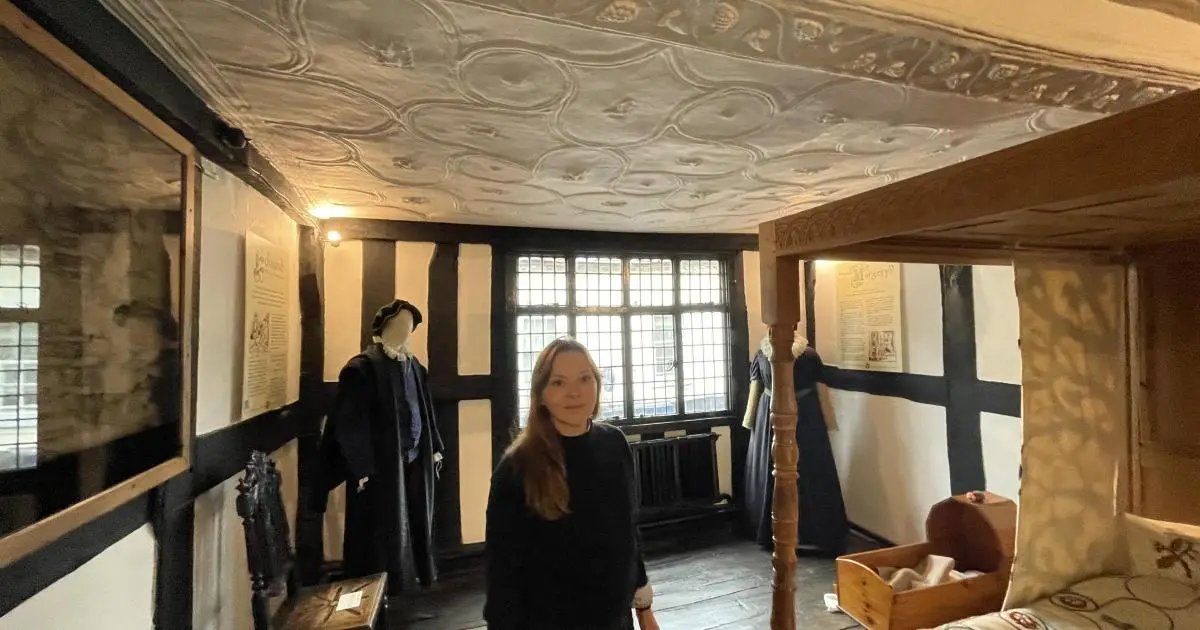
VISITOR numbers are rising at a city museum which shines a light on the wealth and majesty of the Tudor Age – and one particular spellbinding feature leaves many enthralled.
Tudor House Museum in Friar Street in Worcester sees around 20,000 visitors per year – and its charm, and a lottery-funded revamp, mean more people are visiting each year.
Perhaps its pièce de résistance is the restored Tudor ceiling but information boards, introduced in 2020, help people gain a fuller understanding of the museum and the artefacts within its walls.
ORNATE: The embossed Tudor ceiling at Tudor House Museum in Friar Street in Worcester (Image: James Connell/Newsquest)
Abi Haywood, the manager and curator, has explained the appeal of the museum and how lottery funding has helped make the most of its assets, not only restoring them but providing a more comprehensive explanation of their context.
We have previously reported how Tudor House Museum was awarded a £61,000 grant to help restore its historic ceiling, a Tudor embossed plaster ceiling in The Bedchamber or best room.
Ms Haywood explained that 17 layers of paint had to be painstakingly picked away to reveal the ceiling in its full glory.
The plaster ceiling contains a staggering array of patterns and designs, including the Tudor Rose, lions passant, vines and fleur-de-lis which captured the wealth of a vanished and sometimes overlooked trade which once brought wealth and prestige to the city and even relief for the city’s poor who had fallen on hard times.
STRIKING: The front of Tudor House Museum in Friar Street, Worcester (Image: James Connell/Newsquest)
“It shows the wealth of Worcester when the wool and weaving industry was in the city. Broadcloth made Worcester really wealthy. Lots of people don’t know that the wool trade in Worcester was one of the major trades. People know about porcelain and the glove trade, but the wool trade was incredibly important,” she said.
Tudor House is closely associated with the Cottryl family and, from 1580, the room was Edward Cottryl’s best room. The family were clothiers and were only ‘moderately wealthy’ despite the grandeur of the ceiling, created in the late 1500s.
STUNNING; A Tudor Rose on the grand ceiling at Tudor House Museum in Worcester (Image: James Connell/Newsquest)
Ms Haywood says visitor numbers have risen steadily since the Covid-19 pandemic in 2020.
“We have increased our visitor numbers each year. We rely on donations. It’s free entry,” she said.
However, for a £10 annual fee people from Worcester can secure a friends membership which gives them a 10 per cent discount in the cafe.
Inside ‘secret’ underworld tavern brewing at heart of new historic pub crawl
Rare mysteries of hidden gem Tudor cafe in ‘Worcester’s prettiest street’
We stepped inside the historic Worcester pub keeping pints below £5
Interpretation boards, brought in 2020, have helped tell the story of Tudor House in a new, interesting and accessible way.
The museum could not run without a team of around 50 volunteers who are involved as gate stewards, room stewards and in running the cafe, all of whom enjoying being in the sixteenth century house.
HISTORY: Tudor House Museum is closely connected to the Clothiers, a powerful merchant guild (Image: James Connell/Newsquest)
“We are very optimistic about the direction of travel. Tudor House Museum has gone from strength to strength since the heritage lottery funding” said Ms Haywood.
As well as the volunteers, Worcester Municipal Charities was described by Ms Haywood as great supporters who had funded vital work.
The museum also records the history of the Clothiers (then known as ‘Master Wardens and Commonality of Weavers, Walkers and Clothiers of the City of Worcester’, the most important Merchant Guild in Tudor Worcester. Those not in a guild could not carry out their trade, many from this wealthy industry leaving property and valuables to charity in their wills, including money for alms houses.
