
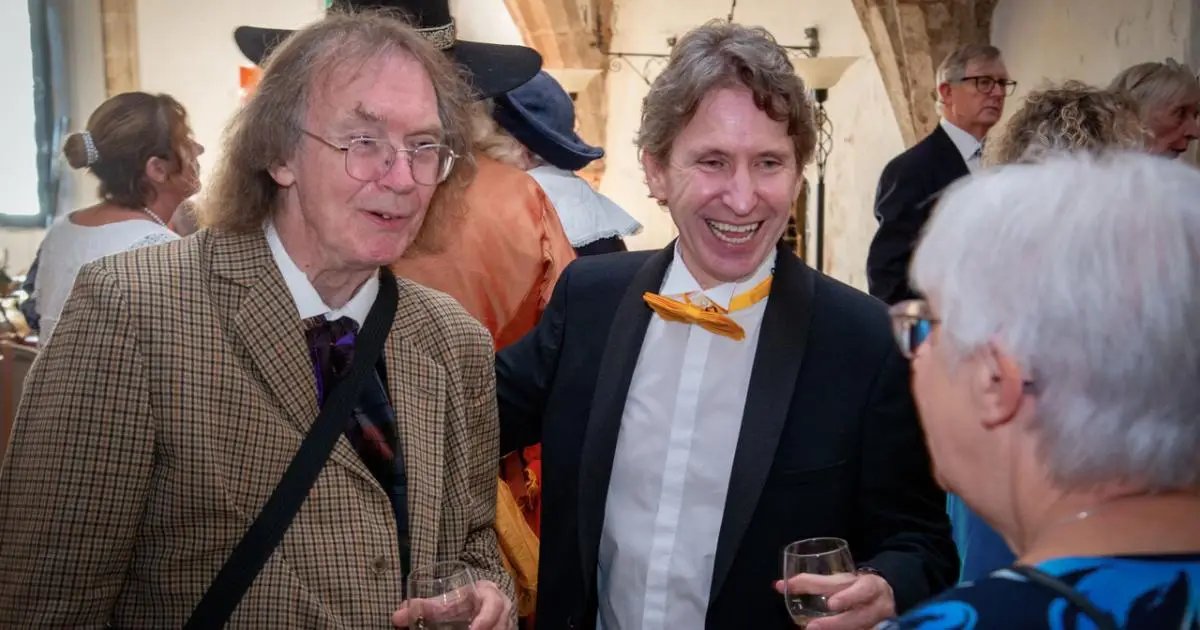
A CELEBRATED historian brought the past to life with an unscripted speech at a dinner commemorating Worcester’s most famous battle as he explained why Charles II lost.
Professor Ronald Hutton entertained guests with the impromptu speech at the Old Palace (Bishop’s Palace) in Deansway in Worcester on Saturday for the Battle of Worcester anniversary dinner.
The dinner, which followed several other commemorative events, marked the 375th anniversary of the battle, the last battle of the English Civil War.
Lord Faulkner of Worcester, a patron of the Battle of Worcester Society, introduced Professor Hutton, also a patron, ahead of the speech which he delivered without notes.
Listening to the talk were dignitaries including the leader of Worcester City Council, Cllr Lynn Denham, the Mayor of Worcester, Tor Pingree, Bishop of Worcester Hugh Nelson and Battle of Worcester chairman, Daniel Daniels, who also spoke of the pivotal importance of the battle.
MUSIC: 17th century music made for a more authentic experience for guests at the Old Palace in Worcester (Image: Battle of Worcester Society)
Professor Hutton, who has written the foreword to the Society’s forthcoming new book, is an Indian-born English historian who specialises in early modern history.
In his speech, he gave a vivid and sober analysis of Charles II’s strengths and weaknesses and how they played out in the Battle of Worcester, fought on September 3, 1651.
The battle is still considered one of the cornerstones of democracy, showing the seeds of constitutional monarchy and cementing Parliament’s role as a bulwark against tyranny.
He said Charles, who fled the battle, had a ‘dash’, knew the right thing to say and had the ability to ‘strike a pose’, ‘knowing what a hero did and acting out the script’.
DASH: Charles II makes an impression at the Bishop’s Palace in Worcester for the anniversary dinner (Image: Battle of Worcester Society)
Professor Hutton added: “What he was not, by any stretch of terms, was a solider, a general, a commander.”
Mr Hutton argued that Charles II lacked the coldness and ruthlessness to win the battle and rally the men under his command and, because of his actions, many of his men were trapped and died in Worcester.
“Charles II’s idea of war was that of a romantic hero from a chivalric tale. Worcester was a battle won by Parliament. It was a battle lost by Charles II,” he added.
OCCASION: The Bishop’s Palace or The Old Palace was a dramatic backdrop for the anniversary dinner (Image: Battle of Worcester Society)
Daniel Daniels, chair of the Battle of Worcester Society, said: “Tonight, we are here to commemorate 375 years since the Battle of Worcester — one of the most important and dramatic events ever to take place in this city, and one which brought the English Civil Wars to their bloody conclusion.
“And what better place could there be to do that than here, in the Bishop’s Palace?”
All you need to know about Battle of Worcester commemorations as anniversary nears
Marchers commemorate final battle of English Civil Wars in city it was fought in
All you need to know about Civil War last battle anniversary at this museum
The event began at 6.30pm and included a dinner, an address by historian Professor Ronald Hutton, and a performance by Musyck Anon.
Guests were invited to attend in black tie, lounge suits, or 17th-century period attire.
ATTENTION: Daniel Daniels, chairman of the Battle of Worcester Society, had no problem getting the attention of guests (Image: Battle of Worcester Society)
He said: “Worcester has a unique place in the story of the Civil War. At Powick Bridge in 1642, the first significant actions of the Civil War took place on the outskirts of the city, and nine years later, in 1651, Worcester witnessed the final battle of the conflict — the battle that shattered the Royalist cause and sent the young Charles II on one of the most remarkable escapes in British history.”
Mr Daniels added: “Imagine Worcester in 1651. “The population of the city was only around 7,000 people, and then, suddenly, tens of thousands of soldiers descended upon it.
“Around 40,000 men, Royalists and Parliamentarians, converged on this relatively small city and its surrounding countryside.”
GUESTS: Cllr Lynn Denham and Cllr Adrian Gregson attended the anniversary dinner for the Battle of Worcester (Image: Battle of Worcester Society)
Mr Daniels also took the opportunity to thank those who made the evening possible, including the Battle of Worcester Society committee, whose work behind the scenes has helped make this anniversary programme possible, and the dinner committee, Brian Bullock, Christine Shaw and John Fidoe.
He added: “In short, we want Worcester to remember that it was not simply the place where the Civil War ended. It was the place where the story began, reached its climax and ultimately changed the course of British history.”
