
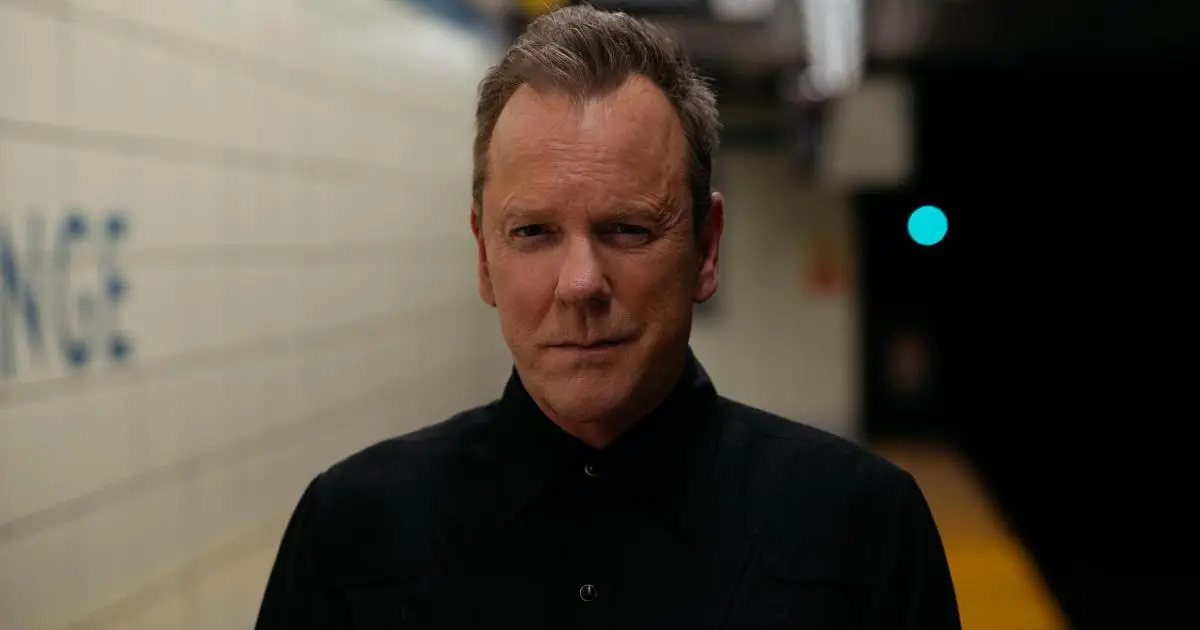
A cult icon, a Hollywood heavyweight, and a rodeo rider turned musician, Kiefer Sutherland reflects on a life shaped by films, songs, and the unexpected paths between them
Kiefer Sutherland is one of those actors who’s always just been there. Not in a background way, but in that way where you don’t quite realise how embedded he is in your film memory until you start pulling the threads together. He was chillingly feral in Stand by Me, then moved into darker, more cerebral territory in Flatliners, a film that leaned heavily on his intensity. In A Few Good Men he commanded attention amid heavyweight performances without ever breaking focus, and in Phone Booth his voice alone did the work. And now, it’s that same voice that’s brought him to Oxford, not for a film set, but to perform his music live on stage.
And of course, before we even get to the music, there’s something that has to come first, because you (I) can’t really begin a conversation with Kiefer Sutherland without going back to The Lost Boys, a cult classic that didn’t just define an era, but cemented a following that has endured, evolved, and only grown more devoted with time. There’s no point pretending neutrality here. For me, The Lost Boys wasn’t just a film, it was a mood, a world, a rite of passage. Alongside late-night encounters with Vincent Price, that unmistakable voice threading through gothic horror, it shaped the atmosphere of my teenage years; dark, dangerous, rebellious and romantic.
So, when Kiefer Sutherland calls, not through a publicist, not via a carefully managed press window, but directly, from his own phone, it lands with surreal familiarity.
There’s no fanfare. Just a voice: ‘Hi Sharon, how are you?’ It’s immediate, warm, unguarded. No entourage, no orchestration. Just a man ready to talk.
I tell him I’ve been a fan for years, that my daughter, now 15, has a The Lost Boys poster on her ceiling. That a film so rooted in the 1980s still pulses through another generation feels remarkable to me.
He doesn’t lean into nostalgia. ‘You never know when you’re making something what it’s going to become,’ he says. ‘I’ve made over 100 films in my life and I couldn’t tell you why one is successful and the other is not.
Kiefer Sutherland
‘You can put everything you have into something, and everyone does, but whether it finds people or not is something you don’t really get to decide. You hope, but you don’t know. And I think that’s something I’ve had to make peace with over time.’
It’s striking, that lack of ownership over legacy. Especially for a film like The Lost Boys, which didn’t just succeed, it embedded itself. It became aesthetic shorthand. Leather, shadows, rebellion. A kind of cinematic folklore. For me, it sat alongside Hammer Horror, those saturated reds, those theatrical shadows forming a kind of visual language for adolescence. Films you didn’t just watch, but absorbed. And yet, for him, there’s no mythology attached. Just work, done honestly, released into the world.
Right now, his focus is music. He’s calling from the road, somewhere between cities, living the life of a touring musician rather than a legendary Hollywood actor. I confess that until this interview, his music had largely passed me by. Knowing I was about to interview, I did my due diligence and spent time with Spotify listening, expecting competence rather than revelation. Instead, I found myself genuinely captivated. Rooted in Americana, with elements of country, blues and folk, the songs are atmospheric and have a storytelling edge, the kind that rewards close listening. Above all, it’s his voice that truly anchors the work: rich and gravelly, weathered in a way that feels earned. It carries warmth, grit and emotional weight, lending the music a sense of authenticity that’s increasingly rare.
‘We played Gothenburg last night. Stockholm tomorrow night. Then Denmark and Hamburg,’ he says. ‘We do three shows, a night off, then three more, so about six shows a week.’
It’s relentless. But what animates him isn’t the schedule, it’s the people who come to see him and his band.
‘The thing I’ve loved about touring more than anything is that whatever preconceived notions an audience might have about me, and whatever preconceived notions I might have about them, when we actually start playing music and telling stories, we start to realise we actually have a lot more in common than maybe we thought. And anytime you get to have that kind of experience with other people, that’s really special.’
He comes back to that idea repeatedly; the dissolving of expectation.
‘You’re just in a room together,’ he says. ‘And that’s actually a very nice place to be.’
Music, for him, isn’t performance in the traditional sense, it’s exposure. ‘The songs that I write are either experiences that are mine personally or things that I’ve observed,’ he explains. ‘I write them from the standpoint of me as a human being. With acting, you stand behind a character. I’m clearly not Jack Bauer. But with a song, that’s me, exposed. There’s nothing to stand behind. It is what it is. And therefore, it becomes very personal, if that makes sense?’
It does. Completely.
Kiefer Sutherland
That rawness, that lack of a filter, is exactly what you hear. It’s what gives his voice that lived-in authenticity. Not polished, not performative. Real.
His new album, Grey, wasn’t conceived as a concept, it emerged organically from place. ‘We were recording most of the record in the UK, and it just happened to be the beginning of winter and everything was just really grey. A friend took a photograph of a tree that became the album cover. The songs I was writing were quite melancholic, so it all just made sense.’
There’s no attempt to intellectualise it.
‘When things line up like that, you don’t really fight it.’
When I ask about music and film, whether he’d ever want his songs to soundtrack a movie, he lights up.
‘I would be thrilled, I’d be honoured if someone chose one of my songs for a film,’ he says. ‘One of my favourite memories is from Young Guns II. Emilio Estevez was friends with Jon Bon Jovi, and he came out to dinner with us because he wanted to be in a western, there was a good chance we thought it might be the last one made.’
Then comes the moment he clearly still marvels at… ‘Later that night, Jon (Bon Jovi) said he wanted to do the music for the film, and he wrote the lyrics to Blaze of Glory on three napkins in about 15 minutes.
‘Fifteen minutes. I remember thinking that was the coolest thing I’d ever seen. But I never expected him to actually follow through and record it, and then he did. And it was incredible.’
He laughs, still slightly in awe.
‘It might take me 20 minutes, or an hour, to get the shape of a song, but then it takes weeks or months to refine it. I envy people who can write that fast, that’s not me. I have to sit with things, come back to them, and keep adjusting until they feel right. It can take months.’
It’s admiration, not comparison. A respect for different kinds of creativity.
His life has never followed a straight line. After Young Guns II, he visited Montana, and what followed wasn’t a celebrity retreat. It was immersion into a new way of living.
‘I went to visit Emilio Estevez in Montana and I never left, I stayed for almost 10 years.’
Life in Montana moves to a different rhythm, Kiefer explains, shaped by horses, cattle and the practical demands of ranching. ‘That’s what people did there,’ he says.
‘You either watch it, or you join in. I joined in. I started working with horses, learning horsemanship, learning roping, and eventually – because that’s what everybody was doing – I got into rodeo.’
He trained with intent. ‘I met a guy named John English and trained with him for about a year. And then [because I asked] yeah, I became a champion for a little bit.’
There’s no emphasis on the achievement. It sits exactly where it belongs, as a by-product of commitment rather than something to be claimed.
Mention the Cotswolds and the conversation shifts naturally to horses again, this time polo. ‘No’ he says when I ask if he’s played. ‘But a friend of mine who’s a polo player, and also a cowboy, borrowed a few of my Quarter Horses, they’re strong, built for work and rodeo. Polo horses are on another level. The horsemanship that’s required to play polo is something I find really fascinating and exciting.’
‘I would like to go to a polo match in the Cotswolds,’ he says.
Then, with a kind of easy acceptance,
‘To spectate, I’m not young anymore. But I’m young at heart. I’ll always be that.’
Kiefer Sutherland
There’s no ego, no need to prove anything.
England clearly holds its own pull. ‘I was born in London and have spent a great deal of time in England and I’ve always felt really welcomed, people have gone out of their way to make me feel that way. It’s always going to be a very special place to me.’
Then, almost casually,
‘I’m always looking at real estate there, I’ve always left that open.’
When filming the Netflix sensation 24, in London, something shifted.
‘It was the only time in my life where I didn’t want to go home. I just wanted to stay in England,’ he says.
It’s easy, in a conversation like this, to forget the scale of what sits behind it. A career spanning more than four decades. An Emmy Award, a Golden Globe Award, multiple Screen Actors Guild Award recognitions. Work that has defined generations.
He doesn’t lead with any of it.
Kiefer Sutherland
When the Netflix sensation 24 comes up, he reframes it simply.
‘The show might have been political, but the character wasn’t. Jack Bauer was apolitical, his job was to protect the president. To me, it was about someone facing insurmountable odds and still trying to deal with them instead of running away. I think most people are capable of that.’
It would be prudent not to mention his father – the late and great, Donald Sutherland – who offered just one piece of advice that stayed.
‘He wasn’t big on giving advice but one thing he did say was: “If a script says the character cries and you don’t feel it, don’t force it. Do something else”.
‘Of course, like any other son, I didn’t listen, and I learned the hard way that he was right.’
Before the call ends, I ask one final question: if his life were a song, what would it be?
He doesn’t hesitate.
‘A happy one. I’m honestly the luckiest person I know. I’ve been able to do what I dreamed of doing and I’ve had incredible support from people around the world. I’ll be grateful for that forever.’
When the line goes quiet, it isn’t the legacy that lingers. Not the films, not the mythology, not even The Lost Boys, despite everything it meant. It’s the ease. The lack of artifice. The sense of someone who, despite extraordinary success, remains entirely present in the moment he’s in.
Warm, open, grounded, instinctive, and generous with his time. A man who has lived many lives – actor, musician, cowboy, storyteller – and yet still approaches each one not as something to master (despite having mastered them all) but something to experience. And somehow, that feels cooler than any cult classic ever could..
The Love Will Bring You Home tour will support the release of his fourth studio album, Grey.
Fans can expect a powerful evening of music and storytelling filled with personal reflections from his remarkable life and career, and the real-world experiences that shape the narratives of his songs.
kiefersutherland.com
