
Although we know it won’t be long before we return to the spring and the light, this time of the year can seem very dark indeed. February can be the most severe month of the winter, and it’s particularly hard for those who have little, those who can’t afford their heating or enough to eat, those who may not even be able to afford a roof over their heads. There have, for a long time, been parables to give us pause for thought about those less fortunate than ourselves, and it’s no surprise to discover that Shakespeare was quite aware of these tales and weaves them into his plays – as happens in Hamlet.
After Ophelia’s father Polonius has been murdered and she has been rejected by Hamlet, the young lady goes mad. Singing mournful songs and holding a bunch of seven flowers, she comes into the midst of a tense meeting between King Claudius, Queen Gertrude, and her brother Laertes. The floral symbolism of the plants she assigns to each person would have been known to Shakespeare’s audience, such as rosemary for remembrance, and pansies for thoughtfulness. In the midst of all this Ophelia mentions an old folktale that, again, Shakespeare must have expected his audiences to know: ‘They say the owl was a baker’s daughter.’
At the water’s edge sits a troubled Ophelia, a fictional character in the play Hamlet by William Shakespeare. Engravings published in 1894. Original edition is from my own archives. (Image: Public Domain..)
Most of the folk tales that my husband Anthony Nanson and I have researched and retold are local legends. They relate to a particular place and possibly a particular time: the last pig in Gloucester during the Civil War siege, the dragon at Deerhurst, King Bladud in Bath. This is different. It’s a cautionary nursery tale, which seems to have been well known in the counties of Gloucestershire, Warwickshire, Worcestershire, and – slightly differently told – in Herefordshire.
The story takes place in the winter. Around Christmas time, there were many different house-visiting traditions. We know about Thomasing on December 21 near Chipping Campden, the hogglers out on Twelfth Night in the Forest of Dean, and wassailers everywhere. All of these traditions had people going round the houses asking for money, food, drink, or all three. This would have tided people through midwinter, but by the end of January the supplies of meat and preserved fruit and vegetables would be getting low and people would be going hungry. Bread was, then as now, the staple of people’s diets. Bakers, at least, probably wouldn’t go hungry themselves!
It was late one cold winter’s night… You see, a bakery keeps late hours to ensure there’s fresh bread for the following day. The baker and her daughter were working hard but were cosy in the warmth of the bread ovens. While they were working, there came into the shop a stranger, dressed all in rags, thin, poor, obviously hungry. The stranger asked for some bread to eat. The baker immediately took a loaf and went to put it in the oven for them. But her daughter seized the loaf and tore off a small piece, saying: ‘That’s enough for the likes of them!’
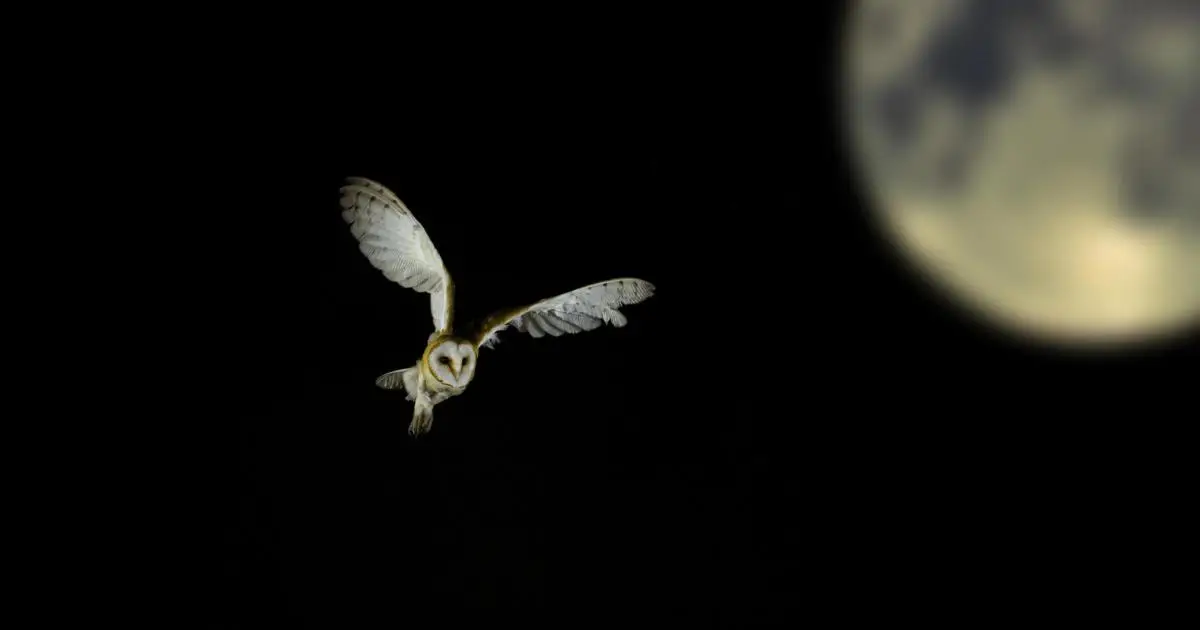
In the oven the tiny scrap of bread began to grow and grow and grow… until the doors of the oven burst open and the bread oozed out into the shop. The baker and her daughter were afraid, but the person at the back of the shop just stared at them sadly. The daughter, infuriated, ran at the stranger, but when she tried to tell the person to get out, the only sound that came from her throat was: ‘Scree, scree, scree!’ Her hands flew to her mouth. But it was a mouth no longer! Hard and sharp, it felt more like a beak! And on her floury arms white feathers were growing. With one last ‘Scree!’ she flew at the stranger, who at that moment opened the door. Out the baker’s daughter soared into the cold, dark night, transformed into a barn owl.
A medieval baker with his apprentice. Bodleian Library MS. Canon. Liturg. 99, fol 26 r.[1] (Image: Scanned from Maggie Black’s ‘Den medeltida kokboken’, Swedish translation of The Medieval Cookbook I)
Much symbolism is attached to owls, both positive and negative. Even today they say that if you hear an owl hoot three times in a row it promises bad luck. Owls were certainly seen as bad omens in Shakespeare’s time. The playwright says of Richard III that an ‘owl shrieked at thy birth, an evil sign’. The owl was a harbinger of death. Lady Macbeth hears an owl just as her husband kills King Duncan. She calls him ‘the fatal bellman’ – imparting good news for Lady Macbeth, definitely bad news for Duncan!
Early in the Middle Ages the owl was said to be a cursed animal. Even in the Bible it is described as unclean. There’s another folk tale that Shakespeare may have known in which the owl steals the rose, a prize for beauty, and keeps it to itself. The owl is then cursed to fly only at night and never see the beautiful colours of the flowers.
Today we think of owls as wise birds, and people in Shakespeare’s time, too, would have been familiar with that characterisation. In The Owles Almanacke of 1618 the owl talks pridefully of being ‘an embelme of wisdom, and so sacred among the Athenians, that they carried the reverence of my picture stamped on their money’.
The barn owl is the most ghostly of owls, all white in the twilight. If you see it flying and it turns towards you, it has a strangely human face. The baker’s daughter is cast out into the winter’s cold. Barn owls, known as poveys in Gloucestershire, were indicators that cold weather or a storm was on the way. Then again, if you heard one screech during a storm, the storm would soon be over.
And the stranger? In Herefordshire, in a tale written down in 1890, the stranger is described as a fairy disguised as an old woman, and both the daughter and the fairy are pretty vindictive. The girl denies the stranger the large loaf and then the old woman thwacks her with her stick and the girl is transformed.
In Gloucestershire the stranger turns out to be someone we not tend to think of today as vindictive: it’s Jesus. Perhaps this is why barn owls so favour church towers as roosting and nesting places. They are places where one can try to get a little closer to God.
As for poor Ophelia, why does she mention the story? Ophelia is sadly transformed – from a good, obedient daughter and sister into a madwoman. She, like the stranger, is rejected – by her fiancé – and, like the baker’s daughter, she may also feel abandoned by God. Might the mention of the tale also prefigure her death? Shakespeare works a lot of symbolic complexity into his plays, much of which, with our different, modern set of references, we can easily miss. Even if the story is sad, it’s wonderful that today we still tell a story that was known by the Bard and maybe was told to him when he was a child. The tale’s moral message remains unchanged from that day to this..
Kirsty’s retelling of the Owl Was a Baker’s Daughter appears in the book Gloucestershire Folk Tales for Children by Anthony Nanson and Kirsty Hartsiotis.
Kirsty Hartsiotis is based in Stroud and available for hire as a storyteller and speaker.
She is an Accredited Arts Society lecturer. Her books include Wiltshire Folk Tales and (with Anthony Nanson) Gloucestershire Ghost Tales and Gloucestershire Folk Tales for Children. She is also the curator of decorative art at a Gloucestershire museum.
