
YOU’LL not hear the name of Olivia Gascoigne mentioned much in any great history book of Worcestershire but had it not been for the efforts of this young lady from Severn Stoke the Australian nation might not exist today.
I jest but not by much.
The 24-year-old servant was among a group of eight female convicts from Worcester deported Down Under on the transport ship Lady Penrhyn in May 1787, having been convicted at the City Assize.
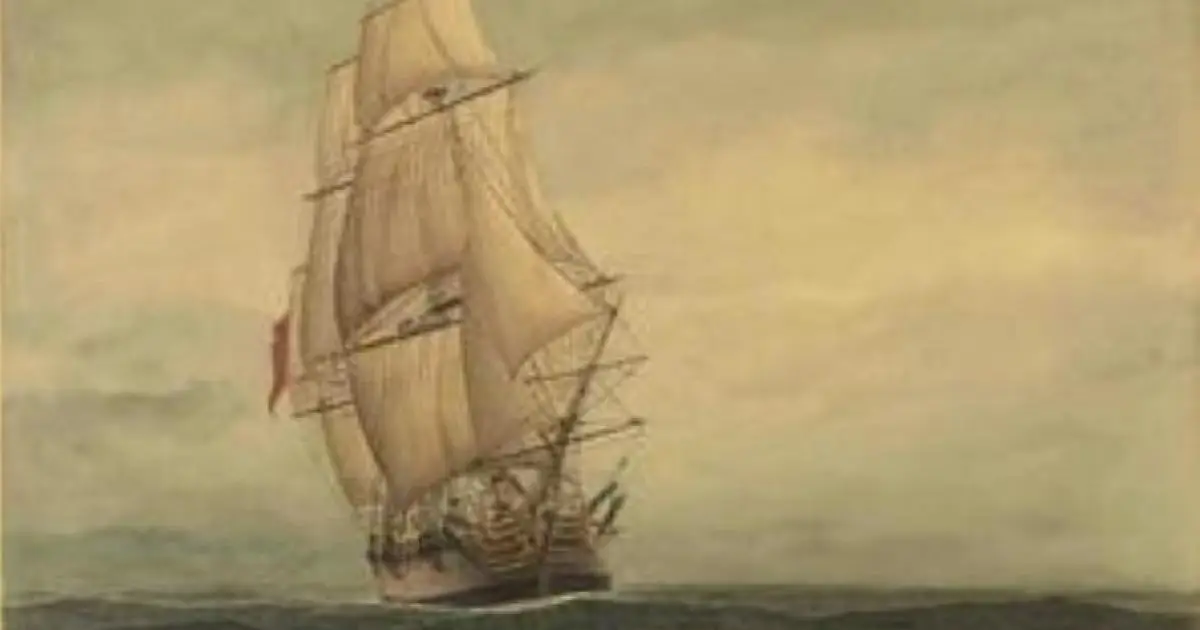
The ship Lady Penrhyn which transported Olivia Gascoigne and seven other women convicts from Worcester to Australia in May 1787 (Image: Newsquest)
No males were chosen, supporting the view the selection of convicts to transport on the first fleet to the proposed colony in New South Wales was not solely based on emptying Britain’s over-crowded prisons.
There was the birth and building of a new nation to consider and Olivia certainly did her bit, giving birth to no less than 13 children. Which was some way beyond the call of duty.
She had been held in the cells at Worcester Guildhall accused of stealing various amounts of money, including 13 guineas and a silver dollar with a value of 13 pounds, 13 shillings and four shillings and sixpence belonging to Edward Griffith from the dwelling house of his father George Griffith at Griffith’s Close in Severn Stoke.
Her trial took place at Worcester Assizes on March 5, 1785. Olivia was the second of the prisoners on the trial docket to climb up the stairs from the cells to the dock to face the judge and jury in a crowded court room.
After all the evidence had been heard the verdict was delivered – “Guilty to be hanged, no goods.”
However, in some ways it was her lucky day. At the end of the Assizes the presiding judge His Honour George Nares, who was retiring, requested clemency from King George III to commute her sentence to seven years’ transportation as his final act on the bench.
More: 15 photos from the 1980s at this city high school
More: 5 Worcestershire homes you can buy now for £350,000 to £400,000
In fact, life in Australia didn’t turn out too badly for Olivia. On the eight-month voyage on the Lady Penrhyn she formed a lasting friendship with fellow deportee Ann Innett from Grimley and the pair were among six women selected for their “vocation and behaviour” to go with Lieutenant Governor Philip Gidley King and nine male convicts to create a settlement on Norfolk Island on February 14, 1788.
Olivia married Nathaniel Lucas, a carpenter from Thames Ditton transported on the Scarborough in the first fleet.
She died at Port Dalrymple in Tasmania and was buried there on June 12, 1830, her age given as 69.
Olivia receives a mention in Worcester Civic Society’s History and Heritage calendar for local events during May over the centuries and here are some more.
May 3, 1852: The first public service on the new Oxford, Worcester & Wolverhampton railway. It was initially very limited, only operating between Stourbridge and Evesham. The conception and creation of the OW&WR (as it was known) was a story of overrunning budgets, big personality clashes, delays and even a physical skirmish during the height of railway mania. The project took seven years from inception to first service.
Evesham station was one of the first stops on the Oxford, Worcester and Wolverhampton railway line (Image: Newsquest)
May 5, 1992: Diana, Princess of Wales, visited Worcester to open St Richard’s Hospice’s former home in Rose Hill. The princess. who received a rapturous reception from waiting crowds, toured the hospice and spent time chatting to patients and staff before travelling to West Mercia Police headquarters at Hindlip Hall to present long service and good conduct awards. Later she moved on to Bromsgrove to officially open the town’s community hospital.
Princess Diana chats with Daisy Beard at the St Richard’s Hospice opening in 1992 (Image: Newsquest)
May 6, 1966: The beginning of Worcester’s decline as one of the UK’s engineering heartlands could well be put down to the events of this day. For it was when one of the city’s most famous names Hardy and Padmore, with a sales reach from London to Shanghai, went into voluntary liquidation.
Founded in 1814, the company’s headquarters were in Foundry Street, just off City Walls Road, and its golden age was between 1850 to 1900 when it was internationally renowned for its fine decorative cast iron work.
A busy street view of the Hardy and Padmore foundry from 1951. The truck on the left advertises Benedict Peas – a household staple of the 1940s and 50s (Image: Newsquest)
May 10, 1999: Prince Phillip was guest of honour at Worcestershire County Cricket Club’s centenary celebrations for a one-day game against the Australians who were warming up before the Cricket World Cup. The club was celebrating its 100th year, both at the New Road ground and in the County Championship. Hosted by club secretary Mike Vockins, the prince planted a ceremonial silver birch tree and stayed so long watching the match he was nearly late for an evening appointment in London.
Prince Philip planting a tree at Worcestershire CCC’s New Road ground in May 1999 (Image: Newsquest)
May 14, 1203: Pope Innocent III canonized Bishop Wulfstan who had been the Bishop of Worcester from 1062 until his death in 1095. He was made a saint following miracles occurring at his tomb in Worcester Cathedral but during his life he was an exceptional example of devotion and piety. Wulfstan is thought to be the first English Bishop to make a point of visiting his diocese to serve the rural folk, reconstructed Great Malvern Priory and is attributed with ending the slave trade from Bristol to Viking Ireland.
May 20, 1950: Sir Winston Churchill came to Worcester to receive the Freedom of the City. The decision to bestow the freedom on the then-prime minister had been made back in May 1945, immediately after the end of the Second World War, but it took five years for him to make the visit. When he did the city put on a tremendous welcome with large crowds gathered to see him. A reception at the Guildhall began at 11.45am and was followed by lunch before the national hero departed mid-afternoon.
He’s in there somewhere. Massive crowds outside Worcester Guildhall as Sir Winston Churchill arrives in May 1950 (Image: Newsquest)
May 31, 1928: The last electric tram ran in Worcester. The life of the city’s single and double-decker electric tramcars was comparatively short at just 24 years. They were introduced in 1904 to replace the city’s horse-drawn trams which had operated for 22 years from 1881 until 1903.
Following the final journey a fleet of Midland Red motor buses took over. The transition from tram to motor bus was far from painless for Worcester which was thrown into disruption and trauma for weeks as teams of workmen moved in to dig up miles of tram tracks throughout the heart of the city and along main approach roads.
Its days are numbered as an electric tram makes its way along Foregate Street, Worcester (Image: Newsquest)
