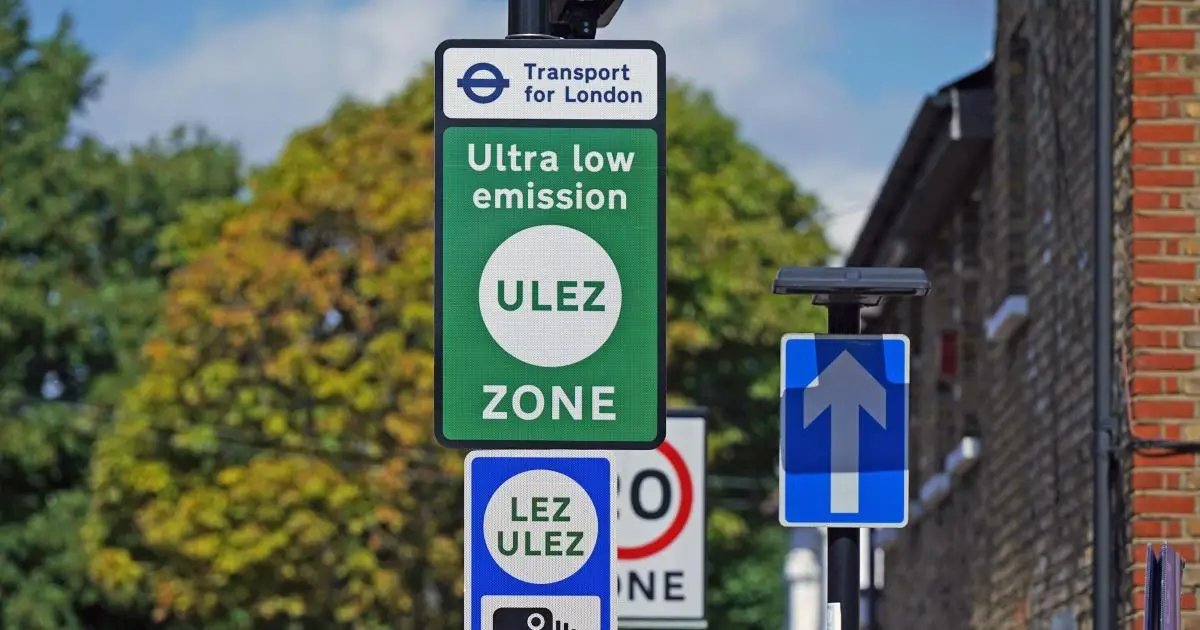
Air quality improvements following the introduction of London’s ultra low emission zone (Ulez) have been linked to improved lung growth in children, a major study has found.
A team of scientists led by Queen Mary University of London measured and monitored the lung health of more than 3,400 children aged six to nine on annual school visits between 2018 and 2022.
They recruited the children from 84 primary schools in London and Luton, with Luton acting as a comparison site because it has a similar mix of traffic pollutants but no clean air zone.
The aim was to assess how air quality changes affected their lung development following the introduction of Ulez in 2019 – which involves a charge for drivers each day they enter any London borough in a more polluting vehicle.
Experts say those who do not have fully developed lungs by early adulthood face increased risks of respiratory conditions, such as asthma, cardiovascular and metabolic disease and premature death as adults.
According to the study, published on Tuesday in the Lancet Public Health journal, initial lung capacity measurements taken before Ulez was introduced showed that children in London had significantly smaller lungs compared with children living in Luton.
However, the data collected over the five years indicated that London children’s lung size and health accelerated and improved to be comparable with that of children in Luton as the zone was implemented.
The findings demonstrated that these improved lung growth trajectories were strongly related to air quality improvements, the scientists said.
Chris Griffiths, professor of primary care at the University of Oxford and at Queen Mary University of London and joint senior author of the report, said: “Traffic pollution in cities damages children’s health and development.
“We provide the strongest evidence yet on how these harms can be prevented.
“Ambitious clean air zones should be considered a priority for cities globally with traffic-related air pollution”.
Many have welcomed Ulez for its impact on health and the environment but opponents say the daily fee negatively impacts people who rely more on vehicles for transport in outer London boroughs as well as low-income households, commuters and small businesses reliant on older vans.
Mayor of London Sir Sadiq Khan, who oversaw Ulez’s introduction, said: “Introducing and expanding Ulez involved incredibly difficult decisions.
“It was very tough, and a vocal minority backed by vested interests made it extremely difficult, but I refused to stand by while air pollution continued to damage Londoners’ health.
“This research proves we were right to act and reinforces my decision to extend the benefits of cleaner air to every child in London.”
To evaluate the children’s lung health and development, the team assessed their forced expiratory volume in one second – or FEV1 – a measurement of how much air can be forcefully exhaled from the lungs in one second following maximal inhalation.
They looked at the results in relation to exposure to nitrogen dioxide (NO2), which is the pollutant most reflective of exhaust pollution.
The researchers found that within the five years after Ulez’s introduction, London children’s exposure to NO2 fell twice as fast and more than twice as much compared with children in Luton.
As NO2 exposure decreased, they demonstrated that London children’s FEV1 increased by 10ml per year more than children in Luton.
At the end of the five years, the FEV1 was the same across children in London and Luton, indicating that the London children’s lung growth had accelerated during the five years to catch up with the comparison group in Luton.
Over the course of the study, the team also noted that the proportion of children with clinically impaired lung function fell from 14% to 9% in London, compared with a fall from 9% to 7% in Luton.
Ian Mudway, associate professor in the School of Public Health at Imperial College London and joint senior author of the report, said: “Air pollution is a global issue. If we want to improve the lives of children living in high-traffic urban environments, we need bold and ambitious measures.
“Our data demonstrates that clean air zones can be an effective public health intervention to prevent damage to developing lungs”.
Researchers from Queen Mary University of London collaborated with Imperial College London and the universities of Bedfordshire, Oxford, Cambridge, Edinburgh and Southern California, with funding from the National Institute for Health and Care Research (NIHR).