
FROM the fashions of London’s Oxford Street to the practicality of point duty in Liverpool, via a nostalgic whizz around Worcestershire, a new photographic book titled Britain in the 1930s throws light on a decade often overlooked.
With images from every county and city in the country, from Cornwall to Orkney and from Cardiff to Derry, this 616-page tome has more than 900 black and white photos and captures a nation poised between tradition and modernity, revealing everyday life in unprecedented detail.
At least that’s what the press release says and it’s right.
Although strictly they have nothing to do with Worcestershire, I love the snapshots of the policeman directing traffic from his crash-proof podium in Liverpool – why didn’t more towns think of this? – and the glam couple strolling in central London, the very epitome of 30s cool.
Unfortunately when it comes to the section on Worcestershire the bar is not quite so high, featuring, as it does, some well-trodden subjects and locations.
Although they still have merit from a local history standpoint.
It is also a brave claim to make of “previously unseen images” in a publication like the Worcester News which is quite heavy on nostalgia and we have a vast library of old photographs ourselves.
Maybe say the images in this book are taken from a slightly different angle than ours.
Notwithstanding, there is a good view of the pleasure steamers on Worcester’s South Quay against the backdrop of the factory development on the riverside, which is long gone, and a nice shot of St Andrew’s church with its towering spire in the same vicinity.
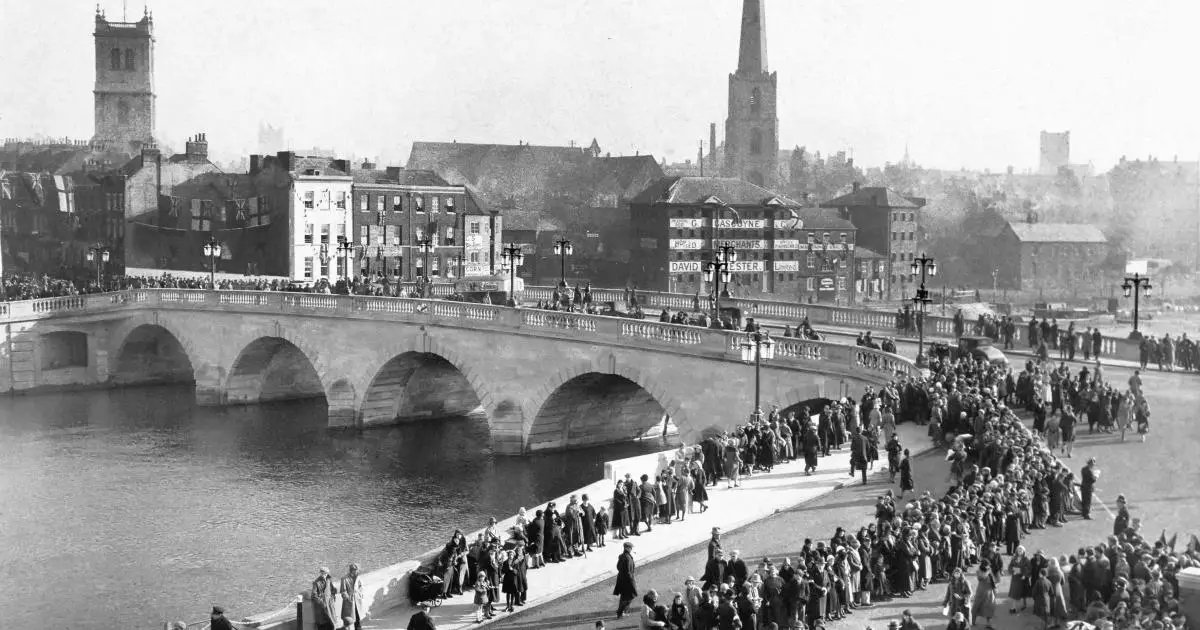
Staying on the riverfront, there are the crowds that gathered on October 28, 1932, to see the Prince of Wales, later the short-lived King Edward VIII, open the widened city bridge, proving once again through thick and thin this country is a monarchy.
Meanwhile, in outback Herefordshire they were herding flocks of sheep along country lanes.
A common sight in rural counties but well captured here on a lonely Wye Valley road that had just been resurfaced with unbound gravel.
Hence the dust being churned up by the car following patiently, or maybe not so, behind.
Britain in the 1930s has been authored by historian Steven Brindle together with writer and teacher Maureen Hill.
Brindle studied history at Oxford and spent almost 40 years with English Heritage in a variety of roles as a historian and Inspector of Ancient Monuments.
He is also regarded as one of the world’s leading authorities on Isambard Kingdom Brunel and is famed for discovering and saving Brunel’s ‘lost’ iron bridge at Paddington.
The book shows that Britain in the 1930s was a land of striking contrasts.
Economic depression and mass unemployment devastated many industrial communities while elsewhere prosperity, suburban growth and consumer culture transformed daily life.
It was a decade in which old ways of life endured even as Britain embraced the modern age.
The 1930s also marked the golden age of the British seaside.
Crowded beaches, bustling promenades, pleasure piers and elegant hotels welcomed millions seeking leisure and escape.
Families enjoyed day trips to Brighton and Margate – from Worcestershire it was more Weston-super-Mare and Burnham on Sea – while Blackpool and Morecambe became synonymous with summer holidays.
Camping, walking and boating holidays grew in popularity as lidos, dance halls and pavilion theatres reflected a new culture of recreation and entertainment.
These photographs capture moments of joy and relaxation during a decade often overshadowed by memories of economic hardship and the approach of war.
It was a case of enjoying the 30s while they lasted.
Britain in the 1930s by Steven Brindle and Maureen Hill is published by Atlantic Publishing and costs £50.
