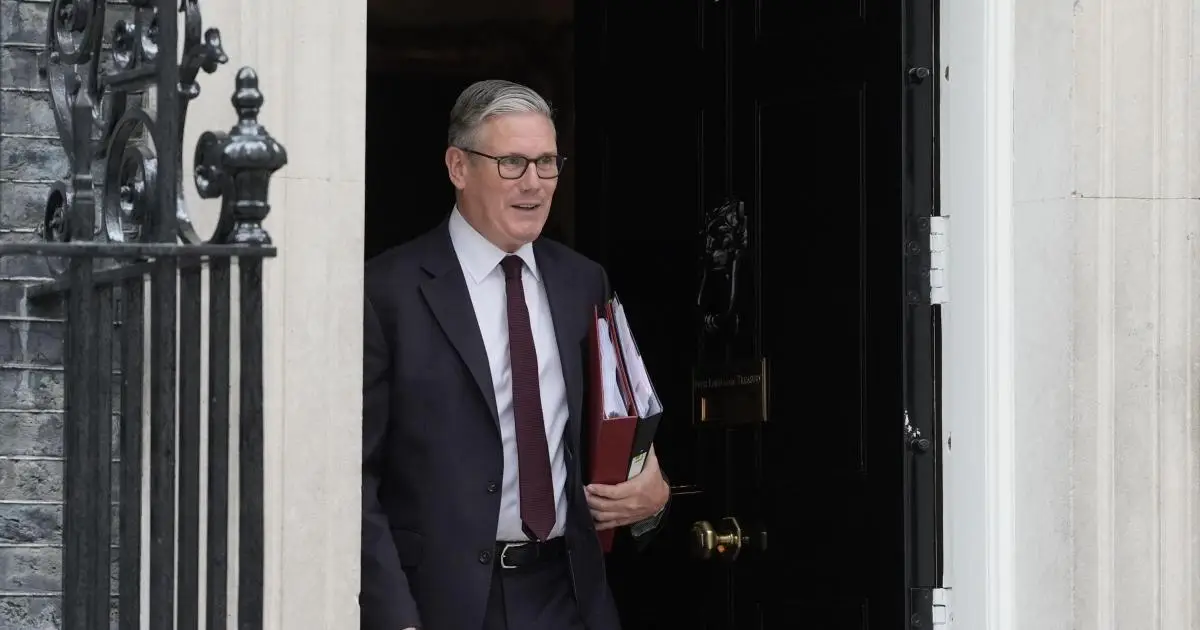
Sir Keir Starmer’s plan to boost defence spending by £15 billion is facing fresh scrutiny, after Downing Street was unable to say where exactly the cuts required to pay for it will come from.
The Prime Minister unveiled the defence investment plan (Dip) on Tuesday, with a promise to increase defence spending by £15 billion, and modernise the armed forces so they are prepared for drone attacks and the threat of Russia.
The Government is yet to spell out how almost a third of the plan will be funded, with a decision on where that £4.7 billion will come from to be made at the Budget in the autumn.
That will prove a headache to Sir Keir Starmer’s successor in No 10, likely to be Andy Burnham, who was only briefed about the funding black hole on Tuesday.
But the Government has also provided scant detail about where the remaining £10.3 billion cuts to Whitehall spending which will fund the plan will come from.
Departments across Government must slash 1% off their spending on major projects to pay for the defence boost, while transport and energy spending will face larger axes.
No 10 revealed that road building projects in Derby and Lincolnshire are among those being sized up in the cuts.
But the Prime Minister’s official spokesman was unable to provide a full list of the projects which will be scrapped to account for the full £10.3bn in savings.
Details will be provided “by the autumn”, he said, also indicating that some hospital building programmes could be cut.
Mr Burnham, who is likely to replace Sir Keir in No 10 in a matter of weeks, is already facing pressure from those in Government to find ways to make up the funding shortfall in the plan.
Defence Secretary Dan Jarvis said he had the “assurance that, as prime minister, Andy Burnham will make sure that we’ve got the investment coming into defence”.
But he acknowledged there would have to be “conversations” with Mr Burnham, vowing he would “fight hard for defence”.
Chancellor Rachel Reeves meanwhile appeared to warn Mr Burnham against further borrowing to pay for the Dip.
Writing in the Telegraph, she said: “A Britain spending beyond its means is a weak Britain – one that is more vulnerable to global shocks like the ones caused by Russia’s invasion of Ukraine and more recently the war in Iran.”
And Sir Richard Knighton, the chief of the defence staff, told reporters that even after seeing through the Dip, Britain must meet its Nato obligation hike defence spending to 3.5% of national economic output by 2035.
“I have been clear and I am on the record as saying that to deliver the strategic defence review and our Nato requirements, we need to spend 3.5% of GDP. The Prime Minister alongside other leaders committed at the Hague at Nato last year to do that,” he told reporters.