
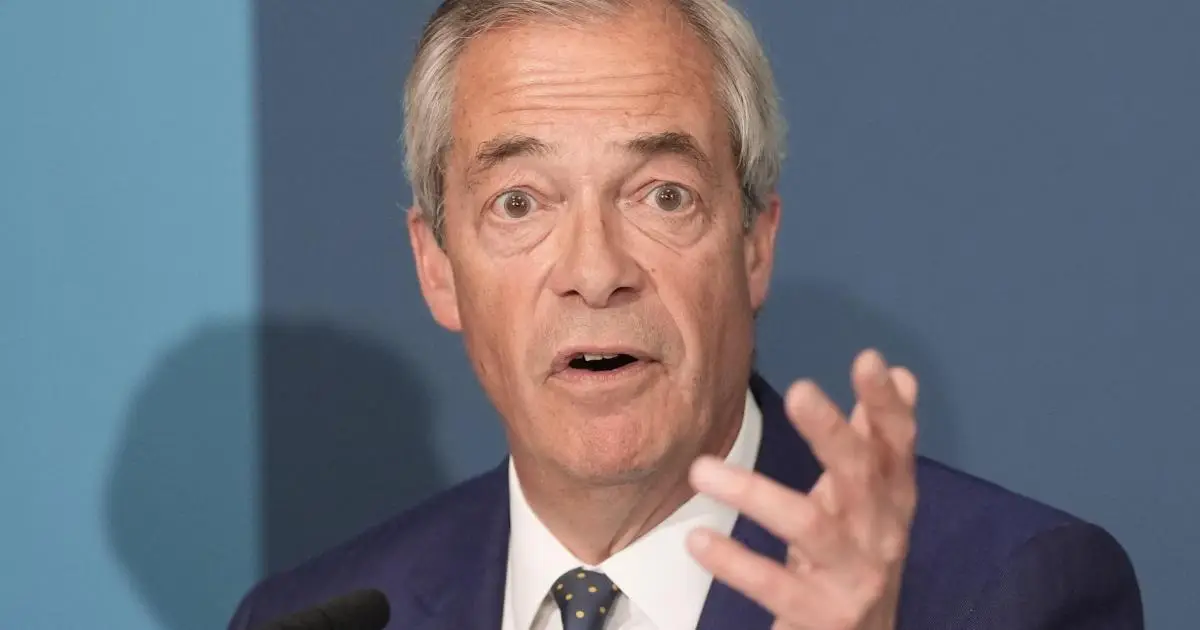
Nigel Farage suggested Reform UK was on course for a general election victory after taking council seats from Labour in early local election results.
Sir Keir Starmer’s party was haemorrhaging seats as local authorities began declaring overnight, in a set of contests that could prove decisive for his premiership.
Reform’s gains exceeded 210 seats when results were in from 37 of the 136 councils in the early hours of Friday, while Labour lost more than 160, including in its traditional northern heartlands.
A jubilant Mr Farage heralded a “historic change in British politics,” telling reporters “there is no more left-right” as his outfit was “scoring stunning percentages in traditional old Labour areas”.
The Reform leader compared the substantial gains to clearing Becher’s Brook, a famously difficult jump in the Grand National.
“If we cleared Becher’s Brook and landed well, we go on to win the Grand National.
“What is very clear to me is that our voters will stick with us now all the way through.”
Sir Keir’s party went into Thursday’s local elections expected to lose up to 1,850 councillors, with senior figures describing the contest as “tough”.
Initial results painted a bleak picture for the Prime Minister.
In Halton, in Cheshire, Labour held two of the 17 seats it was defending as Reform UK gained 15 councillors in the first council to complete its count on Friday morning.
In some wards, Reform won with more than 50% of the vote in an area where last year Mr Farage’s party won the Runcorn and Helsby by-election by just six votes.
Although Labour’s starting position means it retains control of Halton Council, the shift in vote share combined with losses elsewhere in the north west kicked off a difficult night for Sir Keir.
Those results included losses to Reform in Chorley, in Lancashire, and Wigan, in Greater Manchester.
In Hartlepool, Reform won all 12 seats on offer, pushing the previously Labour-held council into no overall control, while Labour also lost control of Redditch, Tamworth and Exeter.
In Tameside, a council in Angela Rayner’s Greater Manchester constituency, Labour lost its majority to no overall control as Reform took 18 of the 19 seats up for election.
While Labour held onto councils in London including Ealing, Merton and Hammersmith and Fulham, the party lost control of Wandsworth four years on from taking over what had been a long-held Conservative authority.
A national drubbing is likely to reignite speculation about Sir Keir’s leadership of the party and the country.
Before polls closed, The Times reported that Energy Secretary and former Labour leader Ed Miliband had privately urged the Prime Minister to set out a timetable for his departure after the elections.
Hartlepool MP Jonathan Brash, whose wife Pamela Hargreaves lost her seat in Reform’s clean sweep, said Sir Keir should go.
He said: “It’s clear to me that the Prime Minister should take this opportunity to set out a timetable for his own departure, and then allow for the widest possible leadership election that includes all the talents of our party.”
But Deputy Prime Minister David Lammy urged his party not to play “pass the parcel” with the leadership in response to the election results.
He told the BBC there were “questions that we have to answer” but there were “no circumstances in which the answer to the questions that the British people are raising is to change the leader yet again”.
Labour sources also pointed to the heavy defeat suffered by the party in 1999 before Sir Tony Blair went on to win re-election by a landslide in 2001.
There were some bright spots for Labour as it clung on in Lincoln, Reading and Salford.
Meanwhile, Mr Farage’s Reform UK is set to make significant gains, building on last year’s local elections that saw the party pick up almost 700 councillors and take control of 10 authorities.
Pointing to the fragmentation of the traditional two-party duopoly, Reform’s Zia Yusuf told the Press Association he expected to see “a turquoise wave” across Labour’s traditional heartlands, with Labour and the Tories struggling “to get 40% between them”.
Early results also showed Reform success further south, with the party picking up seats in Brentwood, in Essex.
The Greens are also expected to do well, with leader Zack Polanski predicting “record-breaking local elections” for the party.
He said it would “take time for the full scale of the Green successes to become clear,” especially in London boroughs to be counted later on Friday, and called for Sir Keir to “listen to the people and go”.
Sir Ed Davey’s Liberal Democrats, eyeing an eighth successive year of local gains, celebrated taking Stockport and Portsmouth councils, which were previously under no overall control.
They also hold all 54 council seats in Richmond upon Thames, after gaining five from the Greens in the south west London borough.
But the Lib Dems lost their majority to no overall control in Hull, losing three seats as Reform gained 10.
It could be another bad night for the Conservatives despite an improvement in party leader Kemi Badenoch’s approval rating, with the party expected to lose further ground to Reform, although it managed to hold Harlow in Essex and Broxbourne in Hertfordshire.
Almost 25,000 candidates were fighting to be elected to more than 5,000 seats on 136 councils across England, where six local mayoral contests also took place.
In Scotland, all 129 seats were up for election at Holyrood while voters in Wales were choosing 96 members of the Senedd.
Votes in Wales and Scotland are not due to be counted until later on Friday, but both elections are expected to pile further pressure on the Prime Minister.
Labour faces losing the national vote in Wales for the first time in more than a century, while in Scotland the SNP appears likely to remain the largest party after 19 years in power.
