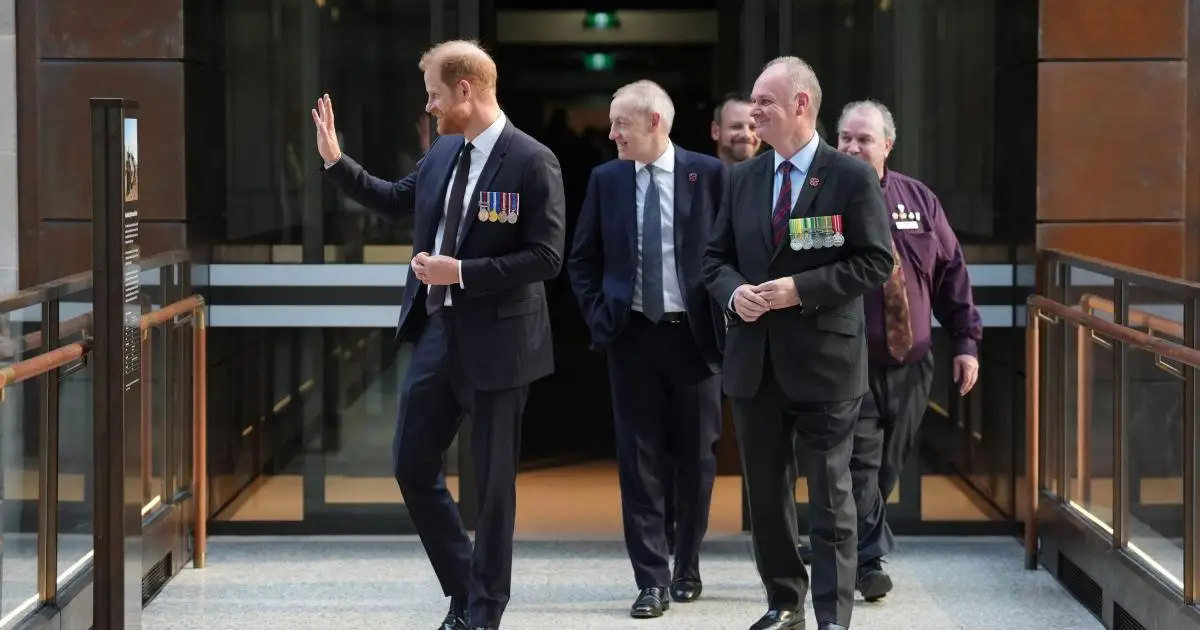
“G’day everybody” said the Duke of Sussex, as he attempted his best Australian accent while praising the work of the Invictus Games.
Harry made the remark while giving a speech about the Invictus Games, which he founded in 2014, to a room full of veterans and their families at the Australian War Memorial in Canberra on Wednesday.
Before the speech, Harry attended a drinks reception for Invictus Australia supporters where he cuddled and kissed a veterans’ assistance dog called Gigi that looked delighted to see the duke.
The duke started his speech by making an Acknowledgement of Country, which is a way of showing respect to Aboriginal and Torres Strait Islander peoples in Australia and acknowledging their ongoing connection to their land.
Wearing a suit with his military medals, Harry said: “I would like to begin by acknowledging the traditional owners of the land on which we gather and pay my respects to elders past and present.”
Once again attempting his best Australian accent, Harry, who was not accompanied by the Duchess of Sussex, said nowhere was the impact of the Invictus Games “more evident than here in good old Australia”.
Just before the duke began speaking, MasterChef Australia announced that Meghan would be featured as a guest judge on the cooking show – describing the duchess as “a passionate foodie with global influence”.
The show said Meghan took part in filming on Wednesday in Melbourne.
It was also announced on Wednesday that Meghan had joined fashion discovery platform OneOff as a “participant and investor to create exclusive edits of her looks and give users direct access to shop her wardrobe”.
The duchess’s outfits from her visit to Australia are visible on the website, which details what she was wearing and how much each part of her look costs.
Harry said the Invictus Games, which uses sport to support the recovery and rehabilitation of wounded, injured and sick current and former service personnel, had “developed into a global movement”.
The biennial event involves 22 nations and around 500 competitors with inspiration for the games coming from Harry’s 2013 visit to the Warrior Games which brings together hundreds of injured American military personnel to compete in adaptive sports as part of their recovery.
Australia hosted the Invictus Games in Sydney in 2018 and the next Invictus Games will be held at Birmingham’s National Exhibition Centre in July 2027.
Harry was given a tour of the Australian War Memorial and its accompanying museum – and was beaming after being given a handmade “Welcome to Canberra” sign by a child at the museum.
The duke said “oh wow” as he was shown a Black Hawk helicopter at the museum and waved to visitors who were shocked to see the surprise special guest.
Harry seemed particularly interested in an exhibition on the Ukraine War and picked up a headphone to listen to part of the exhibit.
Before giving his Invictus speech, Harry witnessed a Last Post Ceremony at the memorial on a gloriously sunny day in the Australian capital.
The duke laid a wreath in front of the memorial’s Pool of Reflection and put a poppy on the Tomb of the Unknown Australian Soldier.
The memorial’s Last Post Ceremony, held each evening since 2013, commemorates an individual serviceperson through storytelling, reflection and the sounding of the last post.
The ceremony Harry attended was dedicated to Lieutenant Irene Ada Singleton who served Australia in the Second World War and died in 1945 while a Japanese prisoner of war in Sumatra.
During his speech, the duke announced that the inaugural Invictus Australia Sports Festival would take place later this year in Perth.
He said the Invictus team were in San Diego reviewing their bid to host the Invictus Games 2029, which will be awarded this summer to either the US, Denmark or South Korea.
The duke said there was already “strong interest” from a number of nations in hosting the games in 2031.
Harry said: “Since the Invictus Games Sydney in 2018, Australia hasn’t just carried the torch – you’ve raised the standard.
“What began as a moment in time with the Invictus Games has grown into continued, sustained support for wounded, injured and sick service personnel and veterans here in Australia.
“That progress made here has become a benchmark for the rest of the Invictus movement.”
Since Invictus began its work in Australia, the games have supported close to 30,000 veterans and families.
Last year, around 9,000 veterans and family members participated in events facilitated by Invictus Australia and around 1,000 volunteers supported Invictus Australia’s local sporting events.