
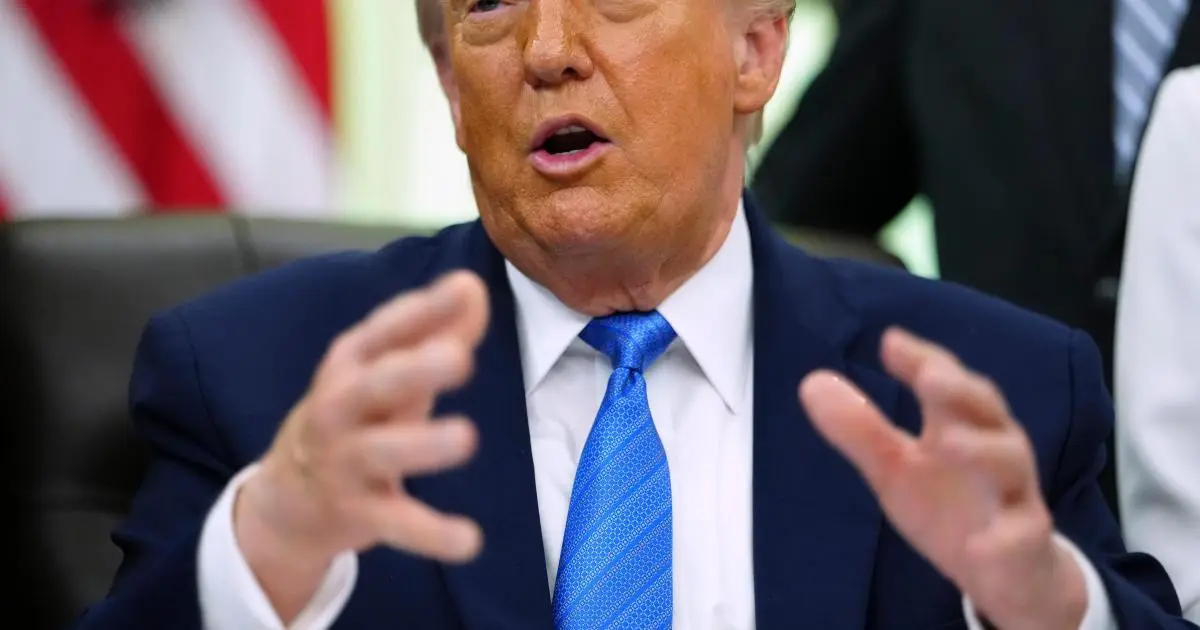
Donald Trump has called off further military strikes against Iran after highlighting progress in talks with the Tehran leadership.
The US president made the announcement just hours after threatening to hit the country “very hard” and seize control of its oil industry.
He issued the warning as both sides continued to exchange fire that risked the return of a full-scale conflict in the Middle East.
But later on Thursday, in a post on his Truth Social platform, Mr Trump said: “Based on the fact that discussions with the Islamic Republic of Iran have been brought to the highest level of Iranian leadership and approved, I have, as President of the United States of America, cancelled the scheduled strikes and bombings against Iran this evening.”
He added: “Discussions and final points have been, in both concept and great detail, approved by all parties involved, including the United States, Israel, Saudi Arabia, UAE, Qatar, Turkey, Pakistan, Bahrain, Kuwait, Jordan, Egypt, and others.
“The Naval Blockade will remain in full force and effect until this Transaction is finalized – Time and place of the signing to be announced shortly.”
However, Mr Trump has claimed repeatedly in recent weeks an agreement was imminent, only for nothing to emerge.
Nevertheless, it marked a sharp about-turn from a previous post where he said the US would take Kharg Island, Iran’s main oil export terminal, although it is unclear how this would be achieved without ground troops.
Mr Trump likened the situation to Venezuela, where the US assumed control of the oil sector after capturing the country’s then-president Nicolas Maduro in January.
In an interview with Fox News, Mr Trump said: “My preference has always been to take Kharg Island.
“I don’t know that America has the stomach for it to be honest.”
He added: “I don’t want to have boots on the ground. But if I wanted to we could put a small group of soldiers and take over the place.”
The latest apparent breakthrough after stalled efforts to end the war came as clashes took the shaky two-month truce to the brink.
Iran’s foreign ministry said the US attacks had “effectively rendered the ceasefire … meaningless” but notably stopped short of saying it was abandoning it.
Central to the negotiations has been Iran’s stranglehold on the Strait of Hormuz, which has disrupted oil and gas supplies and driven up fuel and food prices.
The strategic waterway has become a flashpoint in the conflict, with the US claiming it was in control of the channel after Mr Trump said there had been a secret mission in recent weeks to escort ships through.
However, the number of vessels remained well down on the number transiting before Iran effectively closed the strait in response to the joint US-Israeli offensive at the end of February.
Tensions also remain over Iran’s nuclear plans, which Tehran insists are peaceful but the US and Israel fear could be used to build a weapon due to its stockpile of highly enriched uranium.
Meanwhile, US treasury secretary Scott Bessent has said Washington would use money from frozen Iranian accounts to offset the actions of the Tehran leadership, arguing it would “lose the zero-sum game it is playing”.
In a post on X, he said: “Any damage it inflicts on our allies in the Gulf will be paid for with funds extracted from Iranian Accounts.
“Any tolls paid to the Persian Gulf Strait Authority will be offset by funds extracted from their accounts.
“Every attack Iran launches will only deepen the economic and financial consequences it faces.”
