
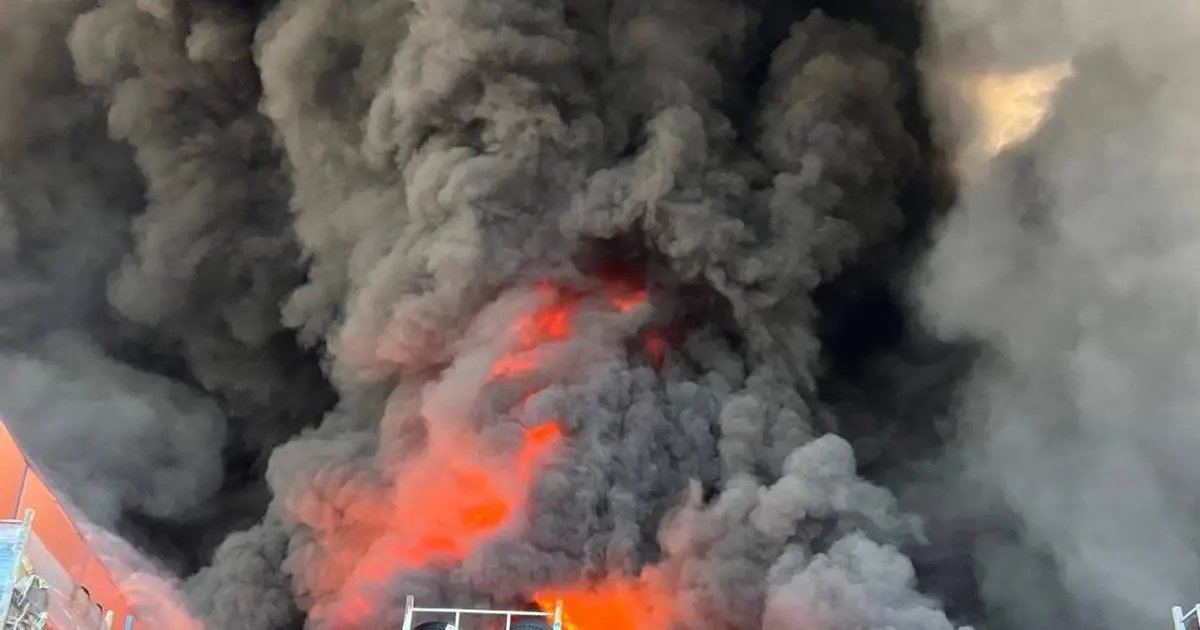
A Russian drone struck a warehouse west of Kyiv that may have been illegally storing munitions in a residential area, according to Ukrainian officials, sparking explosions and fires that damaged dozens of nearby homes and buildings and killing 37 people in one of the war’s deadliest attacks this year.
The Friday night attack on the warehouse in Myla, a village in the Bucha district, came on the second of three days of nearly round-the-clock Russian strikes that have severely disrupted life in and around the Ukrainian capital.
Kyiv officials said an unmanned vehicle hit the building, though they did not specify whether it was one of the jet-powered drones that Russia has increasingly been using to pierce Ukraine’s defences.
The warehouse strike sparked a fire that swept through homes and damaged at least 50 residential buildings, said Tymur Tkachenko, head of the local regional military administration.
Local media later cited him as saying 34 of the people killed were residents of a care home for the elderly and disabled.
More than 370 people were evacuated.
Ukrainian President Volodymyr Zelensky described it as a “terrible situation” and said it appeared to be the result of “terrible negligence on the part of those who stored explosives right next to people”.
The warehouse strike was followed by a detonation, Mr Zelensky said in a statement.
He did not specify what was kept at the site, but he pointed out that Ukrainian law forbids the storage of ammunition close to people’s homes and said criminal proceedings have been opened.
“Those who allowed this to happen must be held accountable for their decisions,” he said.
Ukrainian Prime Minister Serhii Koretskyi also did not offer information on the warehouse, but he referenced a July attack on the Kyiv suburb of Vyshneve that struck an ammunition depot, killing 22 people and triggering large detonations and fires that tore through nearby homes.
“Unfortunately, we can already see that the terrible tragedy in Vyshneve did not become a lesson,” Mr Koretskyi said.
“In the fifth year of a full-scale invasion, making the same mistakes is criminal negligence… And all those guilty, without exception, must be severely punished so that such situations do not happen again.”
Russia’s Defence Ministry said it hit a warehouse in Myla that was storing components and launch boosters for long-range drones.
It also said it attacked the ports of Mykolaiv and Izmail, and a logistics centre and warehouse facilities storing parts for Ukraine’s Flamingo cruise missiles in the Kyiv region.
Drone attacks on the capital and, to a lesser extent, the rest of Ukraine have been nearly constant since Thursday.
Kyiv officials say Russia builds up missile stocks and launches major attacks every few days, hoping to exhaust Ukrainian defences through the sheer weight of numbers.
Russian strikes damaged homes and apartment blocks in the southern Kherson region on Saturday, killing two people and wounding 27 more, including a child, Oleksandr Prokudin, head of the region administration, said in a statement.
Mr Prokudin said earlier in the week that Russia had intensified its attacks on critical infrastructure in the region, which is about 70% under Russian control.
He also urged tens of thousands of residents to move to safer regions because of the possibility of prolonged power and heating outages this winter.
Russia has significantly increased its use of jet-powered drones, and their numbers will keep growing as Moscow sees their effectiveness, Pavlo Palisa, deputy head of Ukraine’s presidential office, told reporters on Friday.
“Means of attack always outpace means of defence. We will certainly need to adapt. It will take time,” Mr Palisa said.
He said interceptor drones currently available to Ukraine, which could theoretically intercept jet-powered drones, have not yet demonstrated the expected effectiveness, though Ukraine is working on solutions.
Meanwhile, Ukraine has stepped up its long-range attacks on Russian military industries and energy facilities in recent months.
The attacks, which use domestically made drones, are meant to cut into a source of Moscow’s war funding and make Russians feel the consequences.
In his evening statement to the nation on Friday, Mr Zelensky said Kyiv hoped to increase its long-range strikes to reach 1,000 drone launches every day.
“Right now, we average over 300 of our long-range sanctions,” Mr Zelensky said, his preferred term for Kyiv’s long-range attacks that have also lately targeted Russian large-scale online retailers.
“There must be more. We have a very specific goal, and we will achieve it.”
Moscow’s forces destroyed 313 Ukrainian drones overnight, Russia’s Defence Ministry said on Saturday.
Ukrainian drone attacks wounded 11 people in Russia’s Rostov region, governor Yuri Slyusar said.
Writing on social media, he said that nine people were taken to hospital, including four children.
