
AS I step inside one of the finest medieval barns in the country, I’m flabbergasted that I don’t even need to show my National Trust card.
Yes, you heard me correctly – the incredible Middle Littleton Tithe Barn, near Evesham, is virtually deserted and you don’t even have to be a trust member to enjoy it in all its splendour. It’s free.
I planned to do the National Trust ‘double’ – a visit to the tithe barn and then a pint at The Fleece Inn in nearby Breforton, a pub dating from the early 1400s which is famous for its mysterious witch circles and preserving all manner of weird and wonderful English folk traditions.
EXCELLENT: The exterior of the National Trust’s Middle Littleton Tithe Barn, near Evesham (Image: James Connell/Newsquest)
The car park for the tithe barn is almost empty. Where are the crowds you see at places like Croome and Hanbury Hall? Do they really just come for the coffee and cake? This building alone is surely enough to satisfy anyone with an appetite for history. Besides, there’s no coffee shop here anyway, no gift shop either. Bliss.
Out of habit, I get my National Trust card ready. But there’s nobody to check it. I put it back in my wallet.
The only other visitors are a young couple who seem not to notice me. They look up, awestruck, at the high beams, a marvel of medieval engineering and craftsmanship. Besides them, there’s not a soul. Soon enough, they leave.
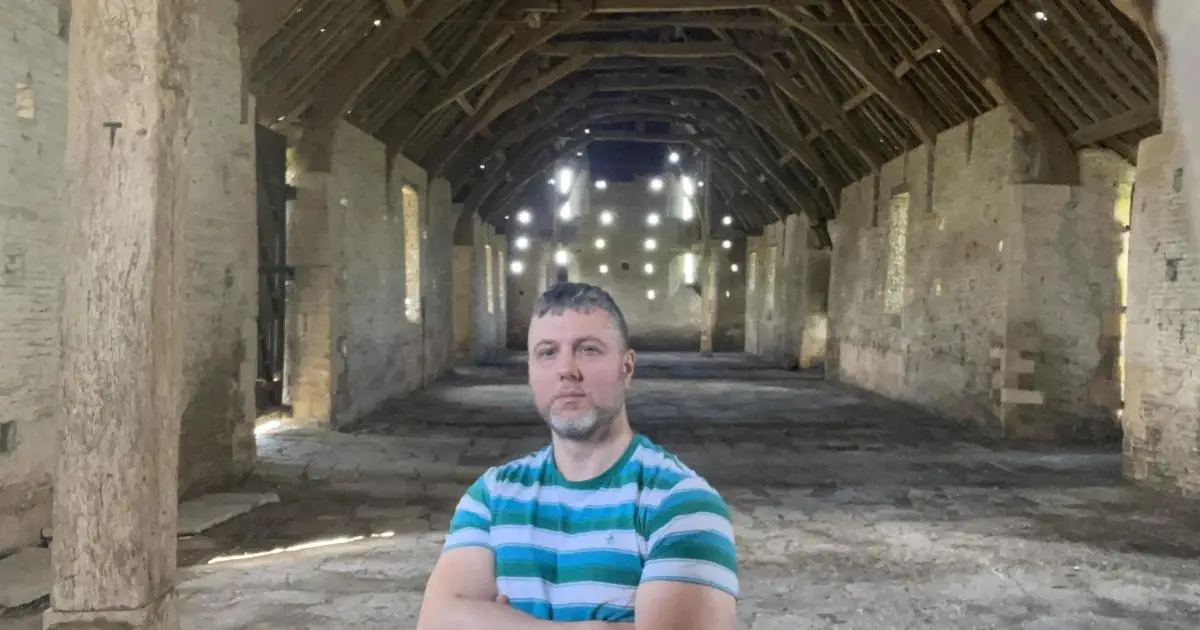
MASSIVE: The impressive interior of Middle Littleton Tithe Barn, managed by the National Trust (Image: James Connell/Newsquest)
All I have for company now are a few roosting doves fluttering up somewhere high in the rafters, shedding a solitary feather which spirals down from the shadows, briefly illuminated by a single shaft of spring sunlight. There is scarcely a sound other than the wind howling through hollows in the massive stone, an eerie, keening sound which only enhances the strange atmosphere.
INCREDIBLE: Middle Littleton Tithe Barn’s amazing roof (Image: James Connell/Newsquest)
I keep on expecting the crowds to arrive. I wander back outside. There’s no sound but the tolling of a church bell. The only living things I see are a murder of crows perched on the roof like a sullen conclave of Benedictine monks, cawing at me somewhat reproachfully, their feathery cowls ruffled by a breath of wind.
Where are all the people? I’m not complaining. I much prefer it like this. I’m just a bit surprised, that’s all. This place deserves more visitors. Maybe I should keep quiet. I like it deserted.
In its own humble way, this grade I listed building is as impressive as the celebrated hammer beam roof of London’s Westminster Hall, built between 1394 and 1401 for Richard II, the largest medieval timber roof in Northern Europe.
What is a tithe barn?
Middle Littleton Tithe Barn is also much older than the celebrated Westminster Hall. Initially, the barn was thought to have been built in 1376 by Abbot John Ombersley but radiocarbon measurements give an earlier construction date of around 1250.
Visit historic barn and beautiful medieval pub ‘in one trip’ say National Trust
National Trust opens ‘one of the largest and finest’ medieval barns in the country
4 major changes to National Trust sites in and around Worcestershire
Charming hidden gem National Trust site you’ve probably never heard of
A tithe barn is where parishioners were charged a tax which then went to support churches and monasteries, in this case, Evesham Abbey. The abbey would extract the tithe on crops and livestock and the produce would have been stored here. It is perhaps a cruel irony that this barn survives when so little of the abbey remains, save a few forlorn ruins, following the Dissolution of the Monasteries in 1540.
MAJESTIC: The Fleece Inn in Bretforton, famous as a filming location for Father Brown (Image: Newsquest)
One of the things that always impresses me about Worcestershire, Herefordshire and Gloucestershire is the sheer volume of beautiful medieval and Tudor buildings like this one.
A favourite of mine, also managed by the National Trust, is Brockhampton in Herefordshire and of course, great pubs with medieval roots like the Three Kings in Hanley Castle or the Fleece Inn in Bretforton.
Northumbrian exile in Worcestershire
I suppose it’s the novelty. I was born in Newcastle upon Tyne, just north of Hadrian’s Wall, and raised near Alnwick in Northumberland, which Pevsner called a ‘rough country’ and a ‘wild county’ at the frontier of what was once the Roman Empire. If Worcestershire, with its rolling green fields, is the equivalent of ‘the Shire’, Northumberland (though it possesses a certain savage beauty) is more like Mordor.
PINT: James Connell at the Fleece Inn enjoys a pint of Pyonner from the Wye Valley Brewery (Image: Newsquest)
Where you have timber-framed merchants’ houses, idyllic moated manors and quaint and pretty dovecotes, I grew up with castles brooding on bleak coastlines (Bamburgh and Dunstanburgh), forts, peel towers and bastle houses, the legacy of incessant wars between England and Scotland and later the blood feuds of the Border Reivers, prized as soldiers across Europe. They say an Englishman’s home is his castle. The Northumbrians took this literally. They had to.
If there ever were timber-framed buildings in the north east, the invading Scots or Duke William in his Harrying of the North would no doubt have burned them all. Perhaps this is what astonishes me – that so much of Worcestershire’s old buildings survive (though much has no doubt been lost).
With so much of the county’s rich Civil War history protected by groups like the Battle of Worcester Society and Visit Worcestershire, it is a county to be proud of. Though I’ll never be one of you, I’m proud to call this county home.
