
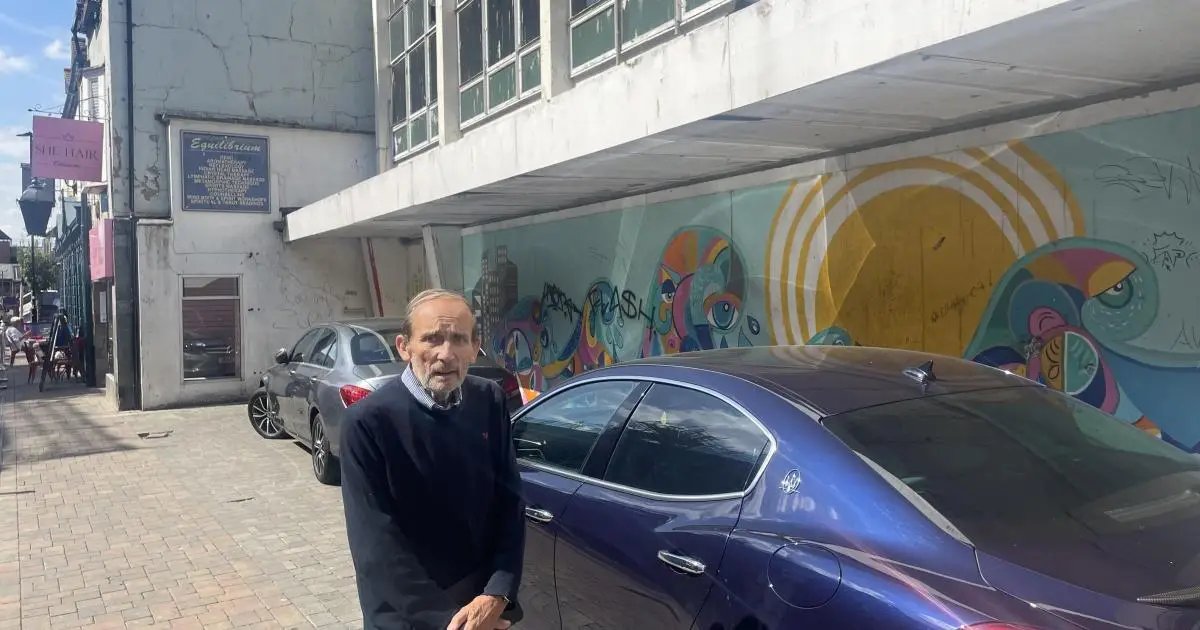
A LEADING developer helping revive the city centre says the High Street must ‘reinvent itself’, but taxation and red tape are acting as barriers to positive change before a single brick is laid.
The poor and declining condition of Worcester city centre has come under the spotlight after Phil Douce, president of Worcester Civic Society, highlighted the issue, arguing that the city was beginning to resemble ‘a slum’.
Now others have added their voice to the chorus of concern on issues which include empty shops, the proliferation of graffiti, broken windows, weeds rooted among crumbling buildings and grime and other grot spots.
Concerns have been raised by councillors, residents, and visitors about the increasing number of empty shops, neglected buildings and anti-social behaviour, with many arguing that the High Street is in need of reinvention to keep pace with changing shopping habits and the wider decline of traditional retail.
BARRIERS: Nick Carroll, an architect and developer, has spoken of the hurdles face in improving Worcester city centre (Image: Supplied)
Nick Carroll, an architect and developer who has worked on several regeneration projects in the city, including the redevelopment of the former Debenhams site, said: “The advent of cashless payments and the unstoppable rise of online retail have irreversibly altered the socio-economic fabric of the High Street—both here in Worcester and across the UK.
“High streets are currently in a delicate state of reinvention.
“It will take years to establish a sustainable new ecosystem centred around city-centre living, co-working spaces, independent leisure, and anchor civic developments like The Scala.
“However, the policy framework intended to guide this transition often acts as a friction point rather than an enabler.”
Worcester city centre ‘turning Into slum’ as urgent clean-up campaign launched
What’s next for Worcester’s empty former Argos store? New plans revealed
Lifeline for rejected plans to demolish newsagents and build new residential building
Mr Carroll said that while local planners are generally supportive of adaptive reuse, they are often constrained by national policy.
He said: “National Space Standards, designed for greenfield new-builds, are often impossible to retrofit into historical urban building footprints.
“Misguided conservation policies often treat the physical pub shell as sacred while ignoring the economic reality of the business inside, which is failing under extreme local taxation and business rates.”
FUTURE: The former Debenhams is due to be transformed into a Kula hotel (Image: James Connell/Newsquest photos)
He warned that redevelopment is becoming increasingly unviable due to mounting costs and regulatory burdens.
He said: “We have actively sought out redundant city-centre heritage assets to date, delivering over 40 apartments alongside shops, offices, and pub venues in Broad Street and Foregate Street, Worcester. However, this active pipeline is hitting a wall.
“The introduction of the New Building Safety Levy, alongside mounting local CIL (Community Infrastructure Levy) demands and Section 106 contributions, treats development as a bottomless pot to tax before a single brick is laid.”
CONCERNS: Cllr Alan Amos, Reform UK leader, has spoken of the poor state of Worcester High Street and the city centre (Image: Supplied)
The former Debenhams will be transformed into a 63-bedroom hotel run by Kula, which already operates hotels in London, Birmingham and Manchester.
Councillor Alan Amos, who represents Lower Wick and Pitmaston on the city council and Bedwardine at county level, said the city centre needs urgent attention from the council.
Cllr Amos said: “We are very fortunate to live in such a great historic city as Worcester.
“Unfortunately, a number of people have complained recently about the state of the city centre saying it is beginning to look run down and dowdy.
“I go to the city centre about four times a week for work and shopping and the city is blessed with a wide range of individual and interesting shops, so it is a great shame that people are concerned that it appears to be declining.”
He acknowledged the broader challenges facing all city centres but said the problems in Worcester are avoidable.
REVIVAL: How Royal Court homes will look at 8 Angel Street in Worcester, site of an empty Co-op (Image: Edited with Google AI)
He said: “Whilst city centres invariably face change, and huge challenges from online shopping, the High Street will always be a place for community interaction.
“There are no alternative hubs for people to congregate and mix. The principal causes of the ‘down-at-heel’ feel is the number of empty shops and buildings which have been left untended and in a state of disrepair.”
Cllr Amos identified Angel Street as a particular problem area, along with the proliferation of Turkish barbers, vape shops, and certain convenience stores.
He also pointed to graffiti, poor pavement conditions, and anti-social behaviour such as illegal cycling through the pedestrianised centre as long-standing issues that need to be addressed.
He said the city needs to “get back to basics,” including keeping the streets clean and graffiti-free, working with businesses to maintain buildings, and taking a tougher approach on anti-social behaviour.
He also called for more rigorous enforcement by trading standards, timely pavement repairs, and stronger action from planning and environmental health teams to uphold standards across the city centre.
A spokesperson for Worcestershire County Council said: “Our town and city centres are inspected on a monthly basis, and we are working alongside Worcester City Council to develop a scheme to improve the paving of the footway in the High Street, which will also see bollards re-spaced.”
A Worcester City Council spokesperson said: “The percentage of empty retail units in the city centre equates to under 10% and this is below the UK average retail vacancy rate.
“In recent years the City Council has been successful in securing Government funding to make significant investment in the city which has brought underused buildings back into use.
“There are some great opportunities for investments in Worcester city centre and the City Council always welcomes conversations with owners and potential investors.
“The City Council has a dedicated team of staff who work hard to keep the city clean and welcoming for residents and visitors.
“We are also introducing a new piece of street cleaning equipment to assist in our cleaning operations.
“We welcome people to help us by reporting any dropped litter or graffiti at www.worcester.gov.uk/report-it”
